
Put three commercial window film quotes side by side, and the heat numbers rarely match. One says the film blocks 97% of the heat. Another says 60%. Most people would rank the 97% bid first, and that can be the wrong call.
Those two numbers can describe the same film. 3M publishes both for its Prestige Series: up to 97% of the sun’s infrared light and up to 60% of the heat coming through the window. Neither number is false. They measure different things, and once you know what each one measures, ranking bids gets simple.
This guide explains the four numbers on every spec sheet and settles the TSER vs IR rejection question. It also covers the one line on a data sheet almost nobody reads. It ends with five questions you can put to any bidder in Seattle, Bellevue, or anywhere else.
Sunlight carries its energy in three bands. The International Window Film Association (IWFA) puts the split at roughly 44% visible light, 53% infrared, and 3% ultraviolet in its solar control education guide. Every number on a film spec sheet describes what happens to some or all of that energy. The trouble starts when a quote uses a number about one band as if it covered all three.
Visible light transmission (VLT) is the share of daylight that gets through the glass and film. Higher VLT means a brighter room. Visible light also carries 44% of the sun’s energy, and it turns into heat when it lands on desks and floors. A clear film lets most of that energy in, because keeping the daylight is the whole point.
Infrared (IR) rejection is the share of infrared light a film blocks inside the band it was tested on. Infrared is the heat you feel on your skin near a sunny window, and it carries about 53% of solar energy. A high IR number is real. It says nothing about the other 47%, and it depends on which part of the infrared band was measured.
Total solar energy rejected (TSER) is the share of all incoming solar energy that stays outside, across ultraviolet, visible, and infrared together. This is the number that tells you how the room will feel on a sunny afternoon. The IWFA guide defines it as one minus the SHGC, shown as a percentage. It measures film and glass together, so the glass under the film changes it.
The solar heat gain coefficient (SHGC) is the fraction of solar energy that ends up inside as heat. It runs from 0 to 1, and lower is better, so a film with 50% TSER has an SHGC of 0.50. The IWFA guide says comfort and cost savings in commercial buildings depend mostly on SHGC. It is also the number any payback estimate should start from, and our payback breakdown for Seattle and Bellevue office buildings covers the other inputs.
| Number | What it measures | Better when | Use it for |
|---|---|---|---|
| VLT | Daylight that gets through | Higher, if you want a bright room | Judging how the room will look |
| IR rejection | Infrared blocked, inside the tested band only | Higher | Comparing films tested on the same band |
| TSER | All solar energy kept out | Higher | Ranking heat performance |
| SHGC | Solar energy that ends up inside as heat | Lower | Energy models and engineering |
Rank bids on TSER or SHGC. Use VLT to judge how the room will look, and treat IR rejection as a supporting detail.
It is the biggest number on the sheet, and it is true. Spectrally selective films are built to block infrared while letting daylight through, so they post high IR numbers. A 97% looks better on a proposal than a 50%, even when both describe the same film. On most competing quotes property managers send us, the IR figure is the largest number on the page.
The IWFA guide itself calls IR rejection percentages problematic. The infrared band is wide, and the sun’s strength shifts from one wavelength to the next, so one percentage can hide a big spread. It also leaves out visible light, which a clear film lets in by design. A room can still warm up under a film with a high IR number.
3M’s own data shows how little the IR headline predicts. The product pages list up to 97% IR rejection for Prestige and up to 61% for the Ceramic Architectural Series. On the data sheets, both on single-pane clear glass with about 60% daylight, Prestige 60 rejects 53% of total solar energy and Ceramic 60 rejects 48%. The IR headlines are 36 points apart, and the TSER numbers are 5 points apart.
We have used both Prestige numbers ourselves, including in our article on why west-facing offices in Seattle and Bellevue overheat by 3 PM. Both figures are accurate. This page explains which one to use for what.
The footnote explains most of it. On 3M’s Prestige page, the 97% carries a note: IR rejection measured from 900 to 1,000 nanometers. The IWFA guide puts near infrared at 780 to 2,500 nanometers. So the 97% describes a narrow slice of the infrared band, and 3M says so on the page.
The 60% is a different kind of number. It is TSER, the whole spectrum, and “up to” covers the range of shades in the line. The Prestige data sheet gives each shade’s exact result. On quarter-inch single-pane clear glass, TSER runs from 50% for Prestige 70 to 62% for Prestige 20, the darkest shade.
Here is what one film on one window can look like on paper. Every figure below comes from 3M, and the last three rows are for Prestige 70 on quarter-inch double-pane clear glass.
| What a quote might say | Figure | What it actually measures |
|---|---|---|
| Infrared rejection | Up to 97% | Prestige Series headline, infrared from 900 to 1,000 nm only |
| Heat rejection | Up to 60% | Prestige Series headline for total solar energy |
| TSER, sun straight on | 44% | Prestige 70 on double-pane clear glass |
| TSER, sun at 60 degrees | 50% | Same film and glass, sun at an angle |
| Solar heat reduction | 21% | How much less solar heat gets in than through the same glass with no film |
Every row is accurate, and a bidder can put any of them on a proposal. Only the last three describe that window, and only if your building has double-pane clear glass.
A real number is one you can check. 3M states its IR band in a footnote, so its 97% is checkable, narrow as it is. The problem is the quote that lists an IR percentage with no band at all. You cannot compare it with anything, so leave it out of the ranking.
The test standard matters as much as the band. The IWFA guide recommends measuring and reporting film performance with National Fenestration Rating Council (NFRC) procedures. It also notes that different standards use different solar spectrums, with at least three in use around the world. Two numbers from two standards are not a fair comparison.
Sun angle is the third check. Standard spec sheet values assume the sun hits the glass straight on, according to the IWFA guide. 3M’s Prestige sheet lists TSER both ways: Prestige 70 on single-pane clear glass reads 50% straight on and 59% at a 60-degree angle. A bid that quotes the angled figure beats a straight-on bid by 9 points on paper, with the same film.
For every number on a quote, ask for four things: the metric, the band if it is IR, the test standard and the sun angle. A bidder quoting from a manufacturer’s data sheet can answer all four in one email.
Every film number is a result for film and glass together. The IWFA guide says data sheets should always state the glass type and thickness behind each value. Most readers skip that line. On 3M’s own Prestige sheet, the glass moves TSER more than the choice of shade does.
Here is Prestige 70 on four kinds of quarter-inch glass, straight from 3M’s data sheet.
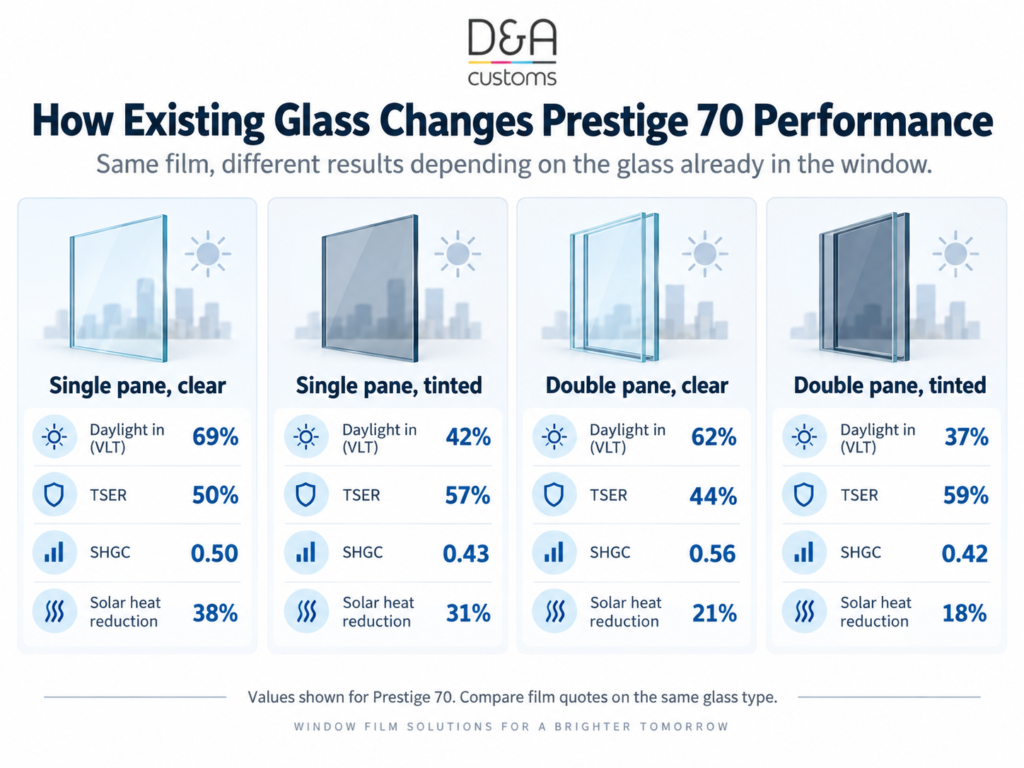
The same film ranges from 44% to 59% TSER. Look at the bottom row: it has the highest TSER and the smallest improvement, because tinted double-pane glass was already blocking heat before any film went on. A bid that quotes that row for a building with double-pane clear glass overstates TSER by 15 points.
Older buildings with repairs or partial replacements can carry more than one glass type, so ask which row applies to each wall. The sheet has no row at all for low-E glass. If your building has it, ask for numbers calculated on your actual glass, plus the film-to-glass check we describe in Can Window Film Break Your Windows?
Darker film blocks more total solar energy, and it also blocks daylight. On single-pane clear glass, Prestige 20 rejects 62% of solar energy and lets in 21% of daylight. Prestige 70 rejects 50% and lets in 69%. Twelve more points of heat rejection cost 48 points of daylight.
The IWFA guide measures this trade with the light-to-solar-gain ratio (LSG), which is VLT divided by SHGC. A score over 1.00 counts as spectrally selective, meaning the glass lets in more light than solar heat. On 3M’s sheet, Prestige 70 scores 1.4 on single-pane clear glass and Prestige 20 scores 0.6. That gap is why we rarely start with the darkest shade in an occupied office.
We pick the lower TSER without much debate in three situations:
A lower TSER on the right wall is a deliberate choice, and a good bid explains it in writing. Where peak heat on west glass is the real problem, film cuts the load on the cooling system, which we compare with equipment upgrades in HVAC vs. 3M commercial window film. For cold perimeter desks in winter, a different film does the job, covered in why the desk by the window is always cold.
Take these to every bidder, including us. A good bidder answers all five in one reply, with the manufacturer’s data sheet attached. If three quotes are sitting on your desk this month, this is the fastest way to compare window film quotes line by line.
Once all three bids answer these five questions, you are comparing the same thing three times. Put SHGC on your glass side by side, check the daylight, and compare price last.
Send us the film quotes you already have, from any installer. We will read each one against your actual glass and tell you what each bid actually offers. You also get a list of what is missing from each spec, whether or not you end up hiring us.
We are a 3M certified window film dealer serving Seattle, Bellevue, Tukwila, Renton, and the rest of Puget Sound. If you are setting a Q4 budget, send the quotes before anyone signs. Contact D&A Customs to start the review.