
Will window film turn my building into a mirror? We get that question on almost every commercial quote we write in Seattle and Bellevue, and it’s a reasonable thing to ask.
The fear traces back to one famous case. In 2013, a curved glass tower in London focused sunlight onto the street below and melted parts of a parked Jaguar. The owner came back after two hours to find the wing mirror, side panels, and badge warped beyond repair. Office workers fried eggs on the pavement to prove the point.
That building had two things your building almost certainly doesn’t. Understanding what they were tells you exactly how much control you have over the way your own glass looks. Here’s the whole picture, from the physics to the product choice.
Plain glass barely reflects anything. The mirror-like look on a modern office tower comes from a thin coating on the glass surface. That coating bounces sunlight back outside instead of letting it soak into the building.
MIT architecture professor Christoph Reinhart explained this on WBUR’s Here & Now. Glass buildings scatter light because a reflective coating has been applied to the glass, and without that coating, the building would take in most of the sun’s energy instead. So the mirror effect is a side effect of a heat control decision, not a style choice made on its own.
Reinhart also made a point worth holding onto. A flat surface that acts like a mirror is not itself a problem. Trouble starts when that mirrored surface is curved inward. We’ll get to that.
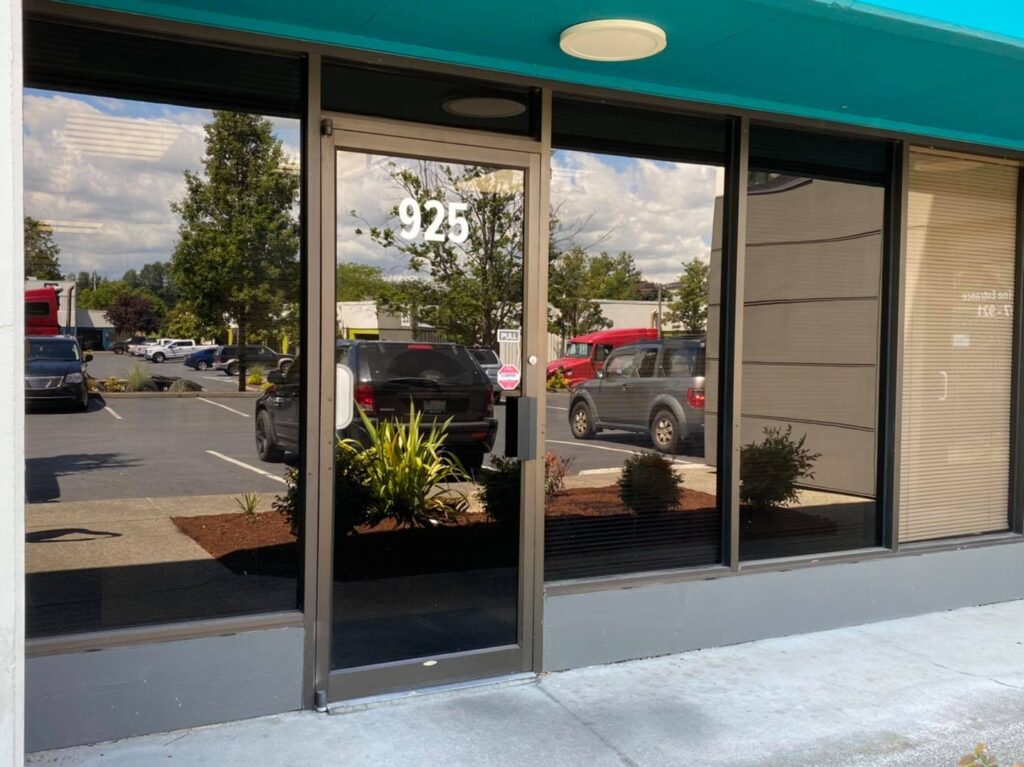
Sunlight carries a lot of heat. Once it passes through glass and hits a floor, a desk, or a wall, that heat stays in the room. Air conditioning then has to pull it back out, which costs money every hot afternoon.
Reflecting sunlight at the glass line stops the heat before it gets in. That’s the whole idea. It’s the same reason a white roof stays cooler than a black one.
Reflective glass gives an owner 3 things at once:
There’s a fourth benefit people rarely mention. A reflective facade looks uniform from the street. You don’t see a patchwork of blinds up, blinds down, and a poster taped to one window on the fourth floor.
Back to London. The Walkie-Talkie has a facade that curves inward, and that curve did something a flat wall never would. It worked like a magnifying glass.
Researchers at Imperial College London studied what happened. The concave, highly reflective face of the building captured, concentrated, and reflected sunbeams down onto the street, creating a beam of intense heat and radiation that moved as the sun moved. Carpets were scorched and office workers fried eggs on the pavement.
The team ran computer simulations to find out how bad it could have been. At its strongest, the beam put out up to 15 times more radiation than a normal London street, and twice what a person can take over thirty minutes before their skin is damaged. Professor Guillermo Rein said the beam caused no serious injury by sheer luck, and that cloud cover plus the path of the beam kept the worst case from happening.
It wasn’t the only case. Reflections from the Museum Tower in Dallas were overheating the Nasher Sculpture Center next door around the same time. The fix in London was straightforward once the problem was clear. The designer changed the original facade and added shading to stop further damage.
Two things caused this, and both had to be present. The glass was highly reflective, and the wall was curved into a bowl shape. Take away either one and there’s no beam.
Here’s where the story connects to ordinary buildings. Your office in Bellevue has flat glass. Flat glass scatters reflected light in one direction instead of focusing it on a point. There is nothing to concentrate.
The other difference is the product itself. Older solar films used metal layers, and metal is what gives you the strong mirror look. Modern commercial film mostly doesn’t work that way. 3M Prestige Series film uses a non-metalized, multi-layer optical film built with nanotechnology, and it’s designed for low reflectivity on both the inside and the outside of the glass.
The performance is still there. Prestige Series rejects up to 97% of infrared light, up to 60% of the heat coming through the window, and up to 99.9% of UV. Independent product documentation puts the exterior reflection of Prestige film at roughly 5% to 9%, which is low enough that the glass looks close to unchanged from the street.
That’s the point we make to property managers who worry about the look. You can cut heat hard and still have a building that reads as glass, not as a mirror.
Two numbers describe how film will change the look of your glass. Learn these and you can read any product sheet.
VLT stands for visible light transmitted. It’s the share of daylight that still gets through. A 70% film keeps the space bright. A 20% film makes it noticeably darker.
Visible reflectance is the share of light bounced back off the surface. This is the number that controls the mirror effect, and most people never ask about it.
3M offers architectural films across a VLT range from about 21% to 70%, and keeps visible reflectivity low, usually under 9%. For comparison, a true mirror reflects most of the light that hits it. A film at 9% is nowhere near that.
On our jobs, the glass you already have matters as much as the film. Older single-pane storefront glass, tinted glass from the 1980s, and modern double-pane units all react differently to the same product. We check what’s on the building before we quote anything, because film and glass have to be matched.
Not every building wants an invisible result. A ground-floor office facing a busy sidewalk may want the reflection. A law firm on the twelfth floor usually doesn’t. Here’s how the main film families compare.
| Film type | Look from outside | Typical VLT | Best fit |
|---|---|---|---|
| 3M Prestige Series | Close to plain glass, low reflection | 21% to 69% | Offices that want heat control without changing the facade |
| 3M Ceramic Series | Neutral, no metal, low reflection | Wide range | Buildings with lots of electronics, or where color has to stay stable for years |
| 3M Traditional Series (silver) | Clearly reflective, uniform | Lower end of the range | Storefronts and lower floors that want daytime privacy and maximum heat cut |
The silver option is not a lesser product. It does a different job. 3M’s Traditional Series silver films reject up to 79% of total solar energy, block up to 99% of UV, and the added reflection helps daytime privacy while giving the outside of the building a more uniform look. 3M cites an energy analysis by CONSOL Energy showing potential paybacks in under three years.
So the question isn’t which film is best. It’s what your building needs, floor by floor. We’ve done projects where the ground floor got a reflective film for privacy, and the upper floors got Prestige, on the same facade, on the same day.
One more thing worth knowing. 3M backs Prestige Series with a 15-year warranty on commercial buildings when the film is installed by a professional. That warranty depends on certified installation, which is part of why we went through 3M’s authorization process.
You don’t have to guess. Reflectivity is easy to judge in person and nearly impossible to judge from a product photo.
We’ll come to your building in Seattle, Bellevue, Tukwila, or anywhere in the Puget Sound area, look at your existing glass, and hold real film samples up against it. You’ll see the difference from inside and from the sidewalk before you commit to anything. We’ll also tell you if film won’t help much on your glass, because that happens too.
Book a free reflectivity consultation and sample viewing, or read more about our solar window tinting work.
Related reading: