
Birds fly into windows because they cannot see glass. Clear glass looks like open air, and shiny glass looks like more sky and trees. Most of these deaths happen at homes and mid-size buildings, and October is when Puget Sound facility teams start finding birds under their windows. Here is why it happens, what fixes it, and which windows to treat first.
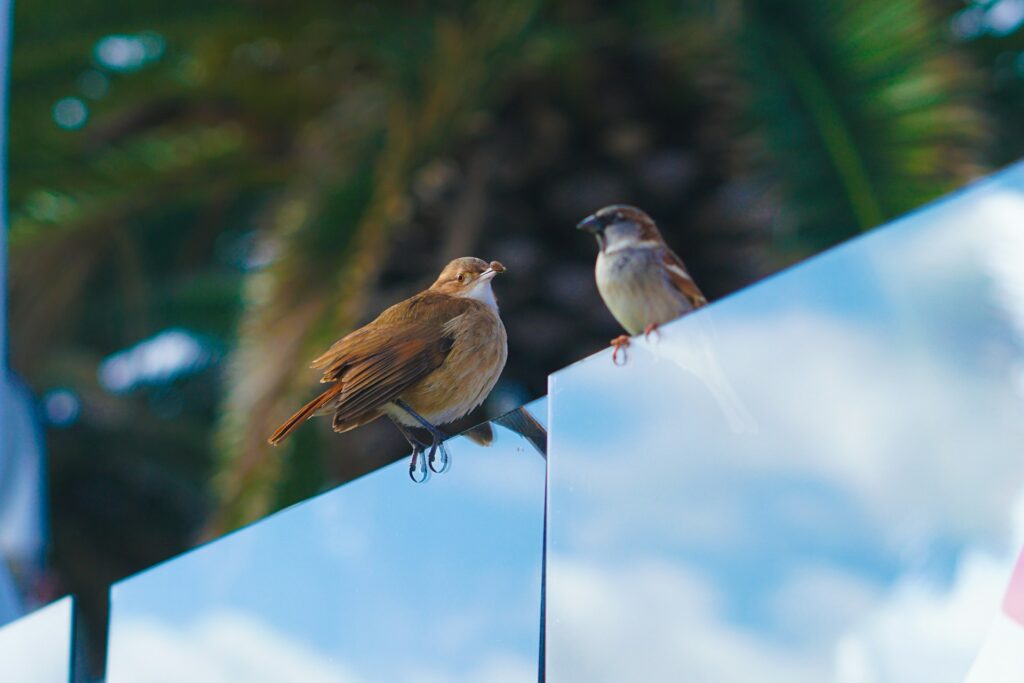
Glass fools birds in two ways. Clear glass shows them the trees or plants on the other side, so they fly toward them. Shiny glass shows them a copy of the trees and sky around the building, so they fly into the copy. Either way, the bird sees no wall.
People spot glass by its frames, smudges and edges. Small songbirds see fine detail far less sharply than we do, the American Bird Conservancy (ABC) explains. A pattern that looks obvious to us may not register for a bird at all.
The same spots cause trouble on most buildings. A University of Washington study of 22 campus buildings found glass railings were the deadliest feature. It also flagged glass walkways, glass corners, and glass near plants and trees. When we survey a site, those are the first places we check.
A 2014 study in The Condor estimated that buildings kill 365 to 988 million birds a year in the U.S. About 56% of those deaths happened at buildings of 4 to 11 stories, and 44% at homes of 1 to 3 stories. High-rises of 12 stories or more caused less than 1%, according to Audubon’s summary.
Towers kill more birds per building, but there are very few of them. The U.S. has about 129 million homes and roughly 21,000 skyscrapers. That puts most of the problem on office parks, schools, clinics and homes. A two-story office next to a greenbelt is a typical site for bird strikes.
Seattle has its own numbers. Birds Connect Seattle volunteers have checked buildings for dead birds since 2021. In 2024, the group estimated that nearly 30,000 birds die at homes and campus buildings during spring and fall migration. Thrushes were the most common victims, followed by sparrows and warblers.
That early number left out offices and most of the year. In May 2026, the group told KNKX it now estimates about 80,000 deaths at Seattle homes alone during migration. Office buildings would add to that total.
One hawk sticker leaves most of the glass open. Birds see the open space as a gap between branches and try to fly through it. Markers only work when they are close enough together that the whole pane looks solid. UW’s standards ban hawk images and decoys for this reason.
The spacing rule has gotten tighter. ABC used to recommend markers 2 inches apart one way and 4 inches apart the other. Later tests showed 4-inch gaps did not stop the smallest birds, such as hummingbirds. ABC now recommends a “2×2 rule”: no more than 2 inches between markers in any direction.
A pattern that works has to meet a few basic rules. This short checklist is based on ABC and UW guidance:
If a quote skips any of these, ask why. One row of dots at eye level helps people, but birds need the full grid.
You may also see a “Threat Factor” score on bird-safe products. ABC tests each pattern with wild birds in a flight tunnel, and a lower score is better. A score of 30 or less counts as bird-friendly. UW warns that the test can overstate real results, so we use the score as a first filter, then check spacing and placement.
Fixing existing glass works. In October 2023, nearly 1,000 birds died in one night at a Chicago convention center, AP reported. The next year, the building added film with small white dots two inches apart. After that fall’s migration, collisions had dropped by more than 95%.
Glass reflects at its outer surface. If markers sit on the inside, that reflection can hide them for much of the day, ABC notes. Dots that look fine from your desk can vanish for a bird outside on a bright morning. That is why UW requires all bird patterns on the outside face of the glass.
Some common fixes fall short in Seattle. UW bans UV-only patterns, which birds see less well under gray skies. It also rules out indoor blinds and shades as a bird fix. Outdoor patterns have to survive rain, window washing and sun, so the material matters.
This work is close to what we already do. Our team designs, cuts and installs vinyl patterns on storefront and office glass across Seattle, Bellevue and Tukwila. Bird patterns use the same layout work, with outdoor-rated material and a tighter grid.
Most buildings don’t need to treat every pane at once. UW’s standards say that treating the worst spots first can prevent many collisions. This is the order we follow on a site survey:
Start with the first two groups, since that is usually where the problem shows up. Then work down the list as the budget allows.
Turning off lights is a free first step. Birds that migrate at night use the stars, and bright buildings confuse them, the AP reported. Lights Out campaigns suggest switching off unneeded lights from 11 p.m. to 6 a.m. during migration, per KNKX. Ask your cleaning crew to close blinds and turn off perimeter lights each night.
The walls that kill birds often overheat in summer too. Mirror-style sun control films cut heat by reflecting light, and that shows birds even more sky and trees. On those walls, the wrong film makes the bird problem worse. We explain how mirror films work in Why Do Some Buildings Look Like Mirrors?
For bird-risk walls that need heat control, we use 3M Prestige. It contains no metal and is designed to keep reflection low, 3M says. On clear single-pane glass, Prestige 70 reflects only 9% of visible light outward, per 3M’s data sheet. It still lets in 69% of daylight while blocking half of the sun’s total energy.
Prestige is a heat and UV film. 3M does not sell it as a bird product, and we don’t either. Its job is to cut heat without making the building shinier. The bird pattern goes outside, and the Prestige goes inside.
Two products on one pane need a quick check first. As a certified 3M dealer, we confirm the glass type and 3M’s guidance before we quote. Film changes how much heat glass holds, which we cover in Can Window Film Break Your Windows?
People markers and bird markers do different jobs. The round markers and glass awareness stickers we install for code sit in bands at about 30 and 60 inches. Birds need a 2-inch grid across the whole pane. Spring migration peaks from mid-April through May, so winter is a good time to plan.
We offer a free bird-strike glass survey for commercial buildings in Seattle, Bellevue, Tukwila, Renton and Kirkland. We find the walls where birds hit, design an outdoor pattern that follows the 2-inch rule, and match it with any heat-control film on the same glass. Contact us to book a walk-through.