
Yes, you can install window film in winter. The pause we hear most in November is “let’s do it in spring,” and it usually comes from a worry about rain and cold. Commercial film goes on the inside face of the glass, so the weather outside matters less than most people think. The real winter difference is time: new film takes longer to dry clear when the glass stays cool and gray.
This guide covers what cold weather changes, what looks normal in the first month, and which films take the longest to dry. It also walks through install day on an occupied floor, so you can plan a winter project in Seattle, Bellevue, Tukwila or Renton without surprises.
Almost all the commercial film we install goes on the room side of the glass. Our crews work from inside the building. Standard films need no lifts, no scaffolding and no exterior access. The glass never comes out of the frame, and a wet week in Seattle does not stop the job.
Weather still matters in a few cases. Exterior films go on the outside face, so they need dry glass and safe access to it. Security film with an edge sealant has a temperature range, which we cover below. Outdoor conditions also set how fast the film dries after we leave, and that is the real winter question.
Film goes on wet. The installer sprays a soap-and-water solution on the glass, lays the film on it, and squeegees most of the water out. Film maker Madico notes that it is nearly impossible to get every drop out. The water left behind has to escape through the film over the next few weeks.
Warm sun on the glass speeds that up, and Seattle gets little of it in winter. KIRO 7 Chief Meteorologist Morgan Palmer describes December through January as “The Big Dark”, when the Northwest gets the least sunlight of the year. Cool, cloudy days keep the glass cool. The water leaves more slowly.
3M builds this into its own guidance. Its visual and care guidelines for 3M window films say final inspection should happen about 30 days after the install. The same page says humid and cooler places can take longer, which describes most of a Puget Sound winter. 3M’s commercial sun control warranty states it plainly: haze may take up to 30 days to clear, and cold weather may need more time.
Slow drying does not mean the film is sitting idle. Madico states that film performs as designed while it dries, and that bubbles and streaks during that time are only cosmetic. The look takes a few weeks to settle. The job the film was bought for starts on the first day.
Most calls we get after a winter install are about how the glass looks in the first few weeks. 3M expects some of it. Its guidelines say water under the film can blur the view early on, and some water bubbles take more than 30 days to go. 3M also asks people to judge film from at least six feet away, straight on, in natural daylight rather than bright direct sun.
Use the graphic below to sort what you see.
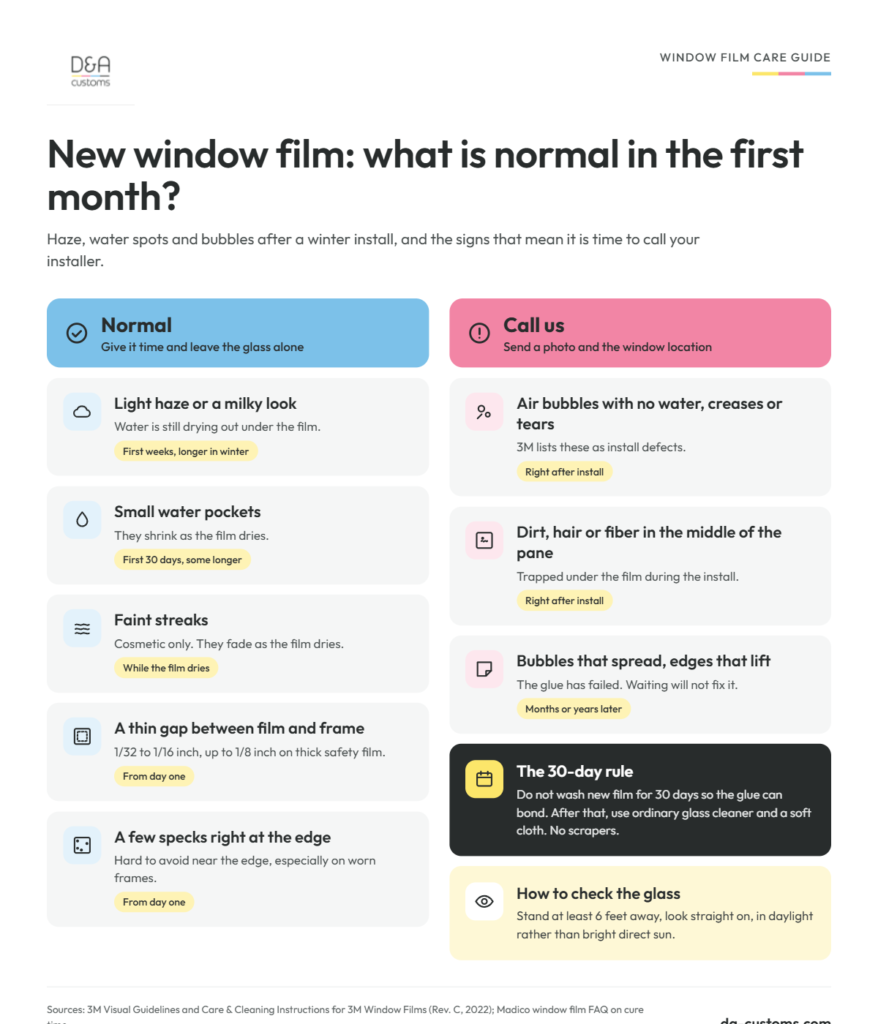
If what you see sits in the “normal” rows, give it time and leave the glass alone. If it sits in the “call us” rows, send us a photo and the window location. Our article on why window film turns purple or starts bubbling explains the long-term failures in more detail.
Drying time depends more on the film and the wall than on the month. Madico gives the two ends of the range. A dark sun control film on south or west glass in a hot summer can dry in a few days. A heavy safety film on north glass in winter can take more than a month.
3M adds that thicker films and films with a metal layer can take much longer to dry completely. Those facts set the slow end of the list below.
The edge sealant needs its own plan. The 3M Impact Protection Attachment (IPA) bulletin says the sealant goes on no sooner than 7 days after the film. It must be applied between 39°F and 86°F (4°C to 30°C). It takes 7 to 14 days to cure on average, and 14 to 21 days to reach full bond. 3M also says not to clean the film and sealant for at least 36 hours after the sealant goes on.
In winter, a metal frame on old single-pane glass can be colder than the room. We check the frame before we run the sealant. On a mixed project, we tell you up front which windows will look hazy the longest, so tenants are not caught off guard.
Facility managers ask about install day before every project. The short answer is that it is quieter than most people expect. Film goes on from inside, window by window, and no glass is removed. Most of our office work runs after hours or on weekends when a floor cannot be disturbed.
Here is how a typical install day runs on an occupied floor.
The one rule for janitorial staff is simple: do not wash the film for 30 days. 3M’s care guidelines set that rule so the glue can build its bond. After that, ordinary glass cleaner and a soft cloth or squeegee are fine, with no scrapers or abrasive pads.
Winter has natural quiet weeks built in. Holiday closures, the week between Christmas and New Year, and school winter break all leave floors empty. An empty floor is the easiest one for us to work on. Schools can finish a whole wing before students come back.
Two other things are worth planning around. 3M recommends installing film after all other trades have finished, so book film after any painting, carpet or ceiling work. If you lease your space, landlord approval can take longer than the install itself. Our guide to what you can and can’t change in a leased office explains how to get that sign-off in writing.
Timing also works in your favor. Film installed in December or January has dried and bonded well before the long, bright days of spring arrive. Waiting for spring means waiting in line when the first sunny week brings a rush of calls.
Following 3M’s application and care steps also protects your warranty. 3M’s commercial sun control warranty applies only when the film is installed properly and cared for as 3M instructs. For security work, 3M’s IPA specification requires the sealant to be applied by a 3M Authorized Window Film Dealer, strictly to 3M’s instructions.
Book a free winter site survey now, and we will plan your project around your building’s calendar. We check the glass on every wall, match a film to each opening, and give you a drying timeline for each film type. Installs run after hours, and your janitorial team gets a one-page care note for the first 30 days.
Contact D&A Customs to book your survey. We work across Seattle, Bellevue, Tukwila, Renton and the greater Puget Sound area.