
Yes, window film can void a window warranty. Some window makers exclude film in writing, and the clause is easy to miss. For a commercial building, the better question is who pays if a pane cracks or a seal fails after the film goes on. Below we cover both warranties, what 3M covers when an authorized dealer, like us, installs its film, and the gaps to check before you sign.
Two separate warranties apply to filmed glass. The first comes from the company that made the window or the sealed glass unit. It covers defects like a failed seal, which shows up as fog or moisture trapped between the panes. The second comes from the film maker and the installer, and it covers the film plus certain glass damage linked to the film.
Different companies write these documents, and they rarely refer to each other. A window warranty may exclude film. A film warranty may step in, but only under set conditions. The table below shows how the two compare for a commercial job using 3M film.
| Window warranty | 3M film warranty (commercial) | |
|---|---|---|
| Who issues it | The window or glass maker | 3M and the 3M Authorized Window Film Dealer who installs it |
| What it covers | Defects in the frame, sash and sealed glass unit | Film performance, plus glass breakage and seal failure caused by the film |
| What can void it | Aftermarket film, under some makers’ terms | Late registration, wrong cleaning, removal by a non-dealer |
| Where to find it | Maker’s website or the building’s closeout documents | 3M’s Warranty Bulletin and your registered warranty |
Most of the confusion we hear comes from reading only one of these documents. Ask for both before you approve a film job.
The answer depends on who made your windows and when. Pella is a clear example. Its Vista Series warranty dated April 2026 lists “window films or other treatments to glass surfaces” under after-market products it does not cover. The same line appeared years earlier in Pella’s 2009 wood window warranty, so this is long-standing language.
Pella’s current document also has a separate table for commercial, condo and rental buildings, with a 10-year term. So the exclusion matters for property owners, not just homeowners. Other makers word this differently, and some say nothing about film at all. That is why a blanket “film usually won’t void it” answer is not much use for your building.
In a commercial building, start with the closeout binder from construction or from the last glazing project. Find the insulating glass warranty and read its exclusions section. Search for the words “film,” “tint,” “coating” and “treatment.” Also check the end date. Once the window warranty has expired, film has nothing left to void.
3M sets out its flat glass terms in the Warranty Bulletin dated March 1, 2026. Glass breakage and seal failure sit apart from the film’s own performance terms. The breakage cover is for thermal stress: a crack that starts when the center of a pane heats faster than its edge. We cover that in more detail in Can Window Film Break Your Windows?
The breakage cover does not apply to impact. 3M’s Glass Checklist states that approved coverage applies to failure caused only by thermal stress. The bulletin also excludes accidents, misuse and vandalism. Here are the commercial terms for glass and seals.
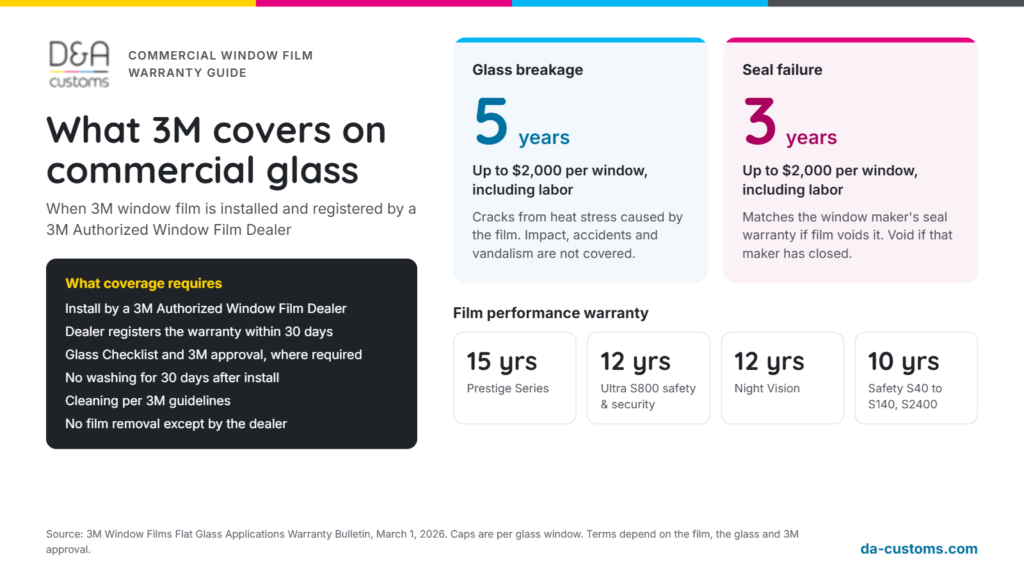
The seal failure line answers the warranty worry most directly. According to the bulletin, the seller “will match the OEM glass manufacturer’s seal failure warranty if the application of window film voids the OEM warranty.” In plain words, if film cancels your window maker’s seal coverage, 3M and the dealer take its place for the covered period, up to the cap. You must first claim from the window maker if that warranty is still valid.
Film performance has its own terms, which vary by product. The bulletin lists 15 years for the Prestige Series and 12 years for Ultra S800 security film on commercial installs. Night Vision also carries 12 years, and the Safety S40 to S2400 films carry 10. These cover the film itself, such as how well it sticks and stays clear.
Coverage starts before any film touches the glass. 3M ties these terms to an install by a 3M Authorized Window Film Dealer. The dealer must then register the warranty through 3M’s eWarranty system within 30 days, or the coverage is void. Film installed by anyone else does not get these terms, which is one reason we became a certified 3M window film dealer.
The glass check matters just as much. 3M’s checklist asks for the glass type, single or double pane, tempered or laminated status, size and thickness. It also asks about the frame and sealant, blinds or drapes, outside shading and heating vents near the glass. For some film and glass pairs, 3M must approve the job in advance. The dealer submits the checklist, and 3M calculates the expected stress at the glass edge and says whether the film is recommended.
3M’s wording on this is blunt: “Dealer failure to obtain 3M’s prior approval will result in no glass breakage warranty.” The March 2026 bulletin also requires a Glass Breakage Questionnaire, plus the checklist where needed, at registration. On our commercial jobs, we confirm these items before we schedule the install:
If any of these is unclear, the install date waits. A week of paperwork costs less than a breakage claim with no coverage behind it.
The film warranty can still be lost after a clean install. Most of the risk comes from cleaning and from removal. The bulletin says windows must not be washed for 30 days after install, while the glue bonds to the glass. Cleaning must also follow 3M’s guidelines for inspection, cleaning and maintenance, or the warranty is void.
Your janitorial team or window cleaning vendor needs to know these rules. Pass along this short list:
Wet winter installs need extra patience, as we explain in Can You Install Window Film in Winter? 3M also asks owners to wait at least 90 days before reporting adhesion or clarity issues. Curing can take 30 days or longer, and early haze often clears. If film fails later, this guide to purple and bubbling film shows what that looks like.
Removal is the other trigger. The warranty is void if the film is removed, unless an authorized dealer takes it off for warranty replacement. This matters at move-out, when a landlord wants the glass returned to its original state. 3M also notes that removal leaves glue residue, and residue is not covered.
No warranty covers every case. We walk clients through these gaps before they approve a job, so nobody is surprised later. Each one comes from the 3M documents linked above:
Older buildings run into the first gap most often. If your glass went in 15 or 20 years ago, the window maker may have changed hands or closed, and the seal match may not apply.
Terms also differ by film brand. Madico’s 2023 commercial and residential warranty covers seal failure only while the window maker’s seal warranty is still in force. Its cap is $500 per window for seal failure and $500 for glass breakage. When you compare quotes, compare the warranty documents along with the price.
A short checklist helps property managers and tenants get clear answers. Ask your installer these questions, including us, and get the answers in writing:
Keep the answers with your lease and building records. The last question matters most for tenants. Our guide to what you can change in a leased office covers it in more depth.
Send us your window warranty or the building’s glazing documents. We check the glass and flag any limits in the window maker’s terms. Then we put the 3M warranty terms for your building in writing before you approve the job. We can’t promise coverage before that check, because terms depend on the film, the glass and 3M’s approval. To start, see our commercial window tinting service or contact our team.