
Etched glass repair is one of the hardest calls a storefront owner has to make. Spray paint and marker on a window come off with solvent and a scraper. A scratch from a key, a blade or a tube of etching cream stays, no matter what cleaner you try. This article explains why, what each kind of damage needs, when polishing works, and how a replaceable film keeps the next mark off the glass.
The question is live in Seattle. The city logged 28,816 reported instances of graffiti vandalism in 2024 and spends about $6 million a year on abatement. Seattle’s graffiti ordinance gives property owners 10 calendar days to remove graffiti, or 48 hours if it is gang- or hate-related.
That rule reaches scratched glass too. KUOW reported that two Capitol Hill businesses, the Bait Shop bar and Olmste(a)d, got city notices over letters scratched into their front windows. One notice set a 10-day deadline and fines of $100 a day, up to $5,000. The Bait Shop’s owner said the fix could mean replacing the whole window. The city told KUOW the notices are not meant as punishment and that it offers removal help, and both owners were given more time.
Paint and marker ink form a layer on top of the glass. They grip the surface, but they do not change it. A solvent softens that layer and a scraper lifts it off. The pane underneath is the same glass it was before the tag went on.
A scratch works the other way around. A hard point drags across the pane and chips out a thin groove. That glass is gone, and nothing grows it back. The groove catches light at a different angle from the flat surface around it, so the letters stay readable from the sidewalk.
Acid etching is the same problem made with chemistry. Craft-store etching cream is made mainly from ammonium bifluoride, which releases hydrofluoric acid when wet. That acid dissolves the silica that glass is made of. The frosted patch it leaves is a spot where a thin layer of the surface has been eaten away. No cleaner can bring that layer back.
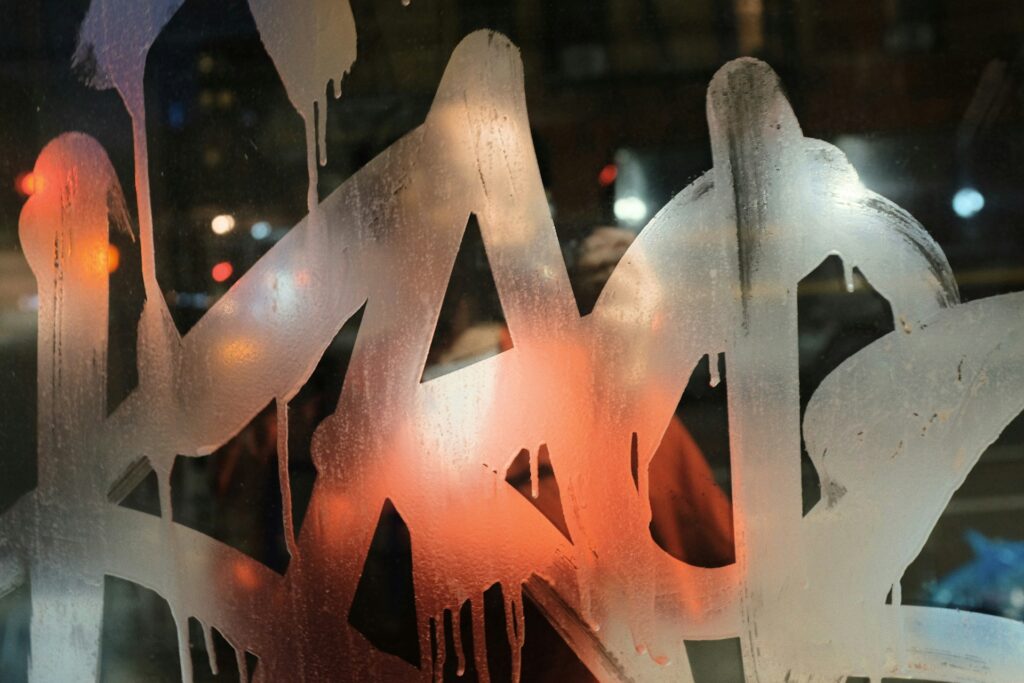
Before you call anyone, work out which kind of damage you have. Run a fingernail across the mark. If your nail catches, the mark is in the glass. If it glides over a raised film or smear, the mark is sitting on top and can likely be cleaned.
The table sorts the three types of damage we see on commercial glass by what each one needs.
| Damage | What happened to the glass | What usually fixes it |
|---|---|---|
| Spray paint, marker, stickers | A layer was added on top. The glass is unchanged. | Solvent and a glass scraper. Nothing needs replacing. |
| Scratches from keys, blades or rocks | Glass was chipped out in a groove. | Light marks can be polished. Deep ones risk distortion, so replacement is often the honest answer. |
| Acid etching from cream or liquid | The surface was dissolved into a frosted patch. | Professional polishing for small areas. Large or deep etching usually means a new pane. |
The first row is a cleaning job. The second and third rows cost real money, and that cost comes back each time the same window gets hit.
Yes, within limits. Glass shops use machines built for this work. C.R. Laurence sells its GForce Max system for tempered, annealed, laminated and low-E glass and for mirrors. The maker lists acid etching among the marks it removes. The same page warns that its abrading discs for deep scratches can cause distortion and should not be used on the tinted side of glass.
That warning explains the whole trade-off. Polishing grinds away the glass around a scratch until the groove is gone. On a light scuff, that layer is thin and nobody notices. On a deep scratch, the polished spot becomes a shallow dip that bends light, and the old letters can turn into a wavy patch.
Storefront glass adds its own limits. Polishing a large pane on site is slow, skilled work. Many storefronts also use tinted glass, which the tool maker says to keep the discs off. When we look at an etched window, we weigh polishing time against the cost of a new pane. We also ask how likely it is that the same window gets marked again next month.
A sacrificial film moves the damage off the glass and onto a layer that is cheap to replace. The clear film bonds to the pane. Keys, blades, paint and etching cream hit the film first. When it gets marked, the installer peels it off and lays a fresh sheet, and the glass underneath stays clean.
3M’s anti-graffiti brochure says the film protects against “most scratches, acid etching, gouges and tagging.” It comes in two thicknesses. The table shows the nominal numbers 3M publishes for each.
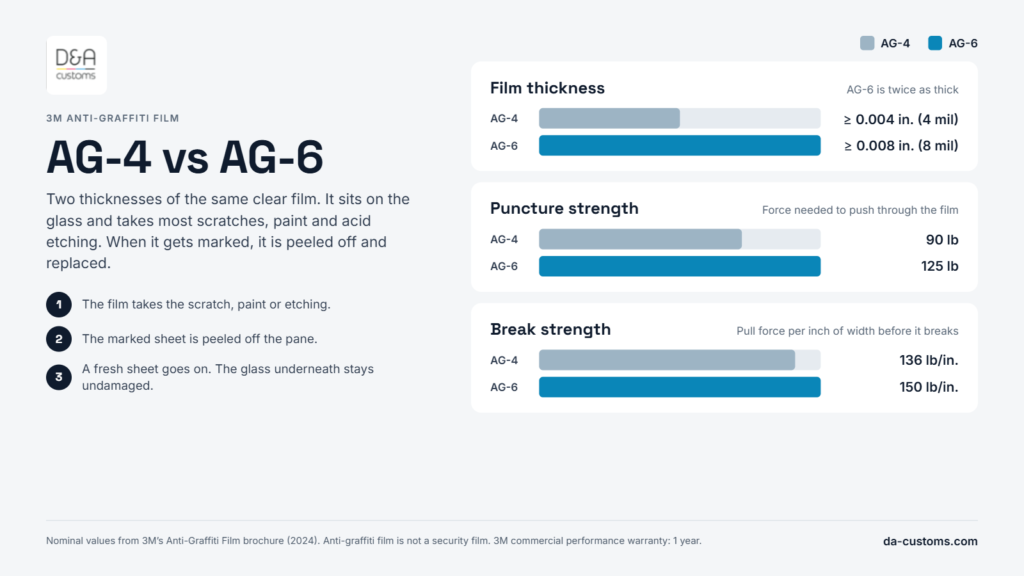
In plain words, AG-6 is twice as thick and takes more force to push through. We usually lean toward AG-6 on doors and low panes that take repeat hits, and AG-4 on higher glass and mirrors where light scuffing is the main risk.
Transit agencies have run the numbers on this approach. In a 2003 board report, LA Metro estimated that film stopped nearly 90% of etched graffiti from reaching station glass. It priced a 42 by 42 in. tempered elevator panel at about $665 to replace, compared with $20 to protect it with film. Those are 2003 prices, but the gap between the two numbers is why the method has lasted.
As a 3M certified dealer, we match the grade to the glass, register the warranty and handle removal ourselves. That last part matters, because a clean removal is what lets the next sheet go on without trapped dirt or old glue.
Film is a maintenance tool with clear limits, and we would rather you hear them from us before you buy. Here is what to expect.
None of these limits is a reason to skip film on glass that keeps getting marked. They are reasons to plan for replacement as a routine cost from the start. For a side-by-side look at film types, see Security Film vs. Standard Window Tint.
For more than six years, we have provided anti-graffiti window film services in Sound Transit rail stations, including work on the new Crosslake Connection stations. Much of that glass sits where riders stand and wait, often with no staff nearby. That makes it a hard test for any protection plan.
The biggest lesson from that work is that glass protection runs on a schedule. The film goes on, it takes hits, and it gets replaced before the marks pile up. Budgeting for those replacement cycles up front keeps the glass readable and the costs predictable.
[CLIENT INPUT NEEDED before publishing. Replace this block with 3 to 4 sentences of real detail]: Which glass gets hit most in stations (elevators, shelters, platform windbreaks)? What is a typical replacement rhythm? What changed after the first replacement cycle? Which film is used at Sound Transit? Do not name 3M here unless confirmed. Confirm permission to describe the work this way.
Most buildings do not need film on every pane. Damage clusters where people can reach the glass and stay out of sight for a minute or two. These are the spots we check first on a walk-through.
If a pane already shows marks, treat it as a map of where the next ones will land. Protect those panes first, then work outward. For schools and public buildings, our article on the benefits of anti-graffiti films for schools and public spaces covers the wider picture.
3M’s own brochure points to peak sales periods, such as events and seasonal tourism, as the times when damaged glass hurts a business most. Holiday shoppers are about to spend weeks looking at your front windows. A scratched pane is easier to deal with now than in the middle of December.
Walk your storefront with us before the holidays. We will mark which panes take the most damage and which existing marks can be polished. We will also flag panes that need a glazier and explain what protecting the rest involves. We work across Seattle, Bellevue, Tacoma and the wider Puget Sound area. Book a free storefront walk or read more about our anti-graffiti window film service.