
You may have seen a video of glass taking several shots and staying in its frame. Or a bid for your building lists ballistic film. Or someone on a school board asks if film on the front doors would stop a bullet. We hear this question from schools, clinics and store owners across Seattle, Bellevue and Tukwila.
The short answer is no, and it comes from 3M, whose security film we install. The longer answer is more useful. It explains what film really does to glass, why sales language makes it confusing, and how to check a claim before you pay for it.
3M answers this question on the S2400 product page for its security film. Does the film stop bullets? 3M’s reply is short: “No, bullets will pass through the film.” Elsewhere, 3M states that its window films are not bulletproof and are not designed to stop intruders.
The window film industry agrees. In September 2024, the International Window Film Association (IWFA) warned the public and schools that security film is not bullet resistant. In February 2025, its executive director said the group knows of no film that stops bullets by itself.
We say the same on our site visits. An installer should never promise more than the company that makes the film. If a quote says otherwise, believe the manufacturer.
Security film is thin. 3M’s Ultra S800 is an 8-mil film, about as thick as two sheets of printer paper. It is made of many very thin layers that resist tearing. That makes it good at holding broken glass, but it is far too thin and light to stop a bullet.
So the bullet goes through the glass and through the film. What changes is what the glass does next. According to 3M, the film helps hold broken glass together. The pane cracks around the hole, but the pieces tend to stay stuck to the film instead of falling out of the frame.
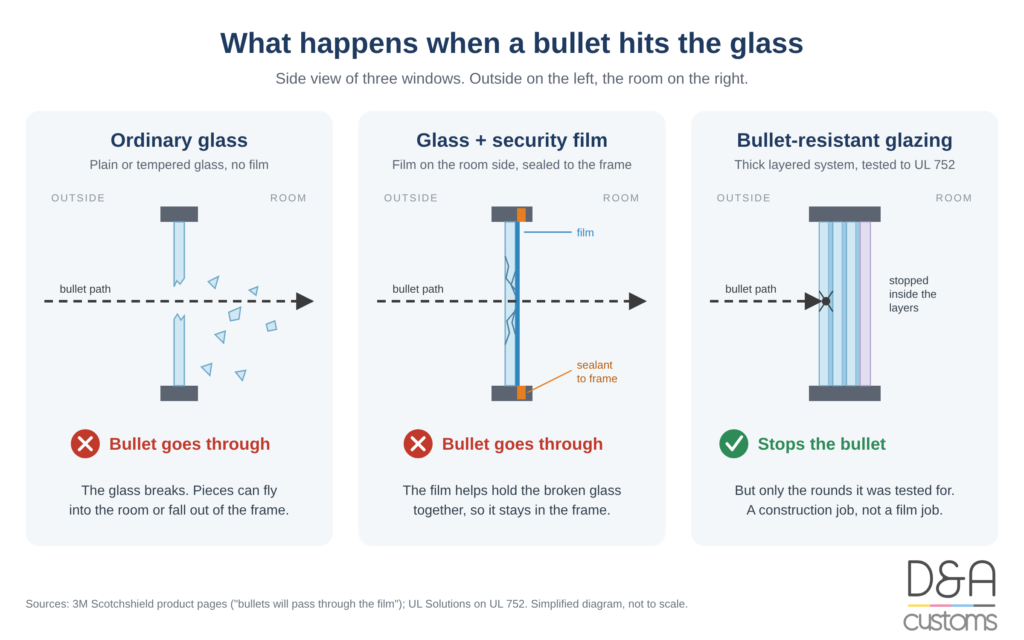
This matters for the people inside. When glass breaks, small chips can fly off the back of the pane into the room. Film is sometimes added to bullet-resistant glass for exactly this reason. The IWFA calls this use a spall shield, and spall simply means those flying chips. That is a real benefit, but it is not the same as stopping the bullet.
No test standard rates a window film as ballistic. The word shows up in ads and bids because it sounds stronger than security film. It has even made it into state rules: the IWFA reports that Missouri’s requirements ask for bullet-resistant window film. So it is easy to see why people are confused.
Demo videos add to the confusion. The IWFA has seen claims that film made glass stop bullets, when the same glass without film performed almost as well. It also warns that many of these tests used unusual test glass that is not generally found in buildings. If the test glass would have stopped the bullet anyway, the video says nothing about your doors.
Glass that really stops bullets is usually tested to a standard called UL 752. To pass, it must stop both the bullet and the flying chips, so a person standing right behind it is not hurt. Each product is tested against specific weapons and ammunition, and its rating covers only those.
That rating belongs to the exact product that was tested. It does not carry over to a different glass, frame or film. Older documents list ratings as Levels 1 to 10, while the newest edition of the standard uses short codes instead.
Glass that meets this standard is thick, heavy and built as a system, with layered glass or polycarbonate in frames made to hold it. Installing it is a construction project, not a film job. That is a different trade from ours, and we say so before we quote anything.
Most of the confusion comes down to a handful of claims we hear again and again. Here is how each one holds up against what the film maker, the industry group and the testing standard actually say. Keep this table handy when you read a security film bid.
| Myth | Fact |
|---|---|
| Security film makes glass bulletproof. | Bullets go through the glass and the film. Film changes how the glass breaks, not whether the bullet gets through. |
| Ballistic film is a tested rating. | No standard rates film as ballistic. A real claim names a standard such as UL 752 and a rating for the exact product. |
| A demo video proves the film works. | The test glass may have stopped the bullet with no film at all. Ask what glass was used and whether it was tested bare. |
| ASTM F3561 in a bid proves the film stops attacks. | That standard tests complete windows and doors, not film on its own. The IWFA calls citing it in a film bid likely misleading. |
| Film does nothing in an attack. | Film attached to the frame holds broken glass in place and may slow down someone trying to get in. |
The pattern is the same in every row. Film is a glass-holding product, and it should be bought for that job.
None of this makes security film useless. It solves problems buildings face far more often. The IWFA says security film helps hold glass in place and may delay entry by an attacker. 3M says its film, paired with its Impact Protection Attachment (IPA) Sealant, can help delay intruders and give extra time to respond.
The sealant is the part cheap bids tend to leave out. It glues the film to the window frame, not just to the glass, so a broken pane is harder to push out. For its S2400 film, 3M lists the IPA sealant as required for every install. We explain how the two work together in our article on film and flying glass.
When we assess a building, these are the openings where film and sealant usually make sense:
Every item on this list is about time and broken glass, not bullets. To compare film types, see security film vs. tint. Store owners can read what film does when a storefront gets hit, and schools can see how we plan around the school year.

These are the questions school boards, property managers and store owners ask us most often after they hear the short answer. Here is what we tell them.
No. 3M’s answer covers its heavy security films too. A thicker film may resist tearing better, but it is still a thin sheet of plastic. In our experience, how well the film is attached to the frame matters more than a few extra mils.
Then you need tested bullet-resistant glazing, not film. Talk to a security consultant and a glazing contractor about which openings need it and which rating fits your risk. Film can still make sense on the rest of the glass in the building, and we are happy to look at that part.
We assess entry glass for schools, clinics, offices and storefronts across Seattle, Bellevue, Tukwila and Renton. We check the glass in each opening and the frames that hold it. Then we tell you where 3M security film with IPA sealant makes sense, and where it does not. As an authorized 3M dealer, we install it to 3M’s instructions, so the warranty is real.
If your security plan calls for bullet-resistant glass, we will tell you that film is not the answer. Book a free security glass assessment, or see our security film and school safety services.