
Condensation on office windows is the glass complaint we hear most often in November. Facility managers find wet sills, foggy panes and dark spots on the frames, and many assume the window leaks. In most cases the water comes from the room air, which drops its moisture on the coldest surface it touches. This guide explains why that happens and how to read where the water sits. It also shows why one popular upgrade, low-E window film, can leave a wet window wetter.
We are a 3M-authorized window film dealer, so you might expect us to say film fixes every window problem. For windows that already drip, 3M advises against its own low-E film, and we follow that advice. Below we explain why, and what does fix the problem.
Air always carries some water as vapor. Every batch of air has a dew point, the temperature at which that vapor turns into liquid or ice. FGIA is the trade group for window and door makers. It explains that water forms on any surface colder than the dew point of the air around it. It also notes that the dew point rises as indoor humidity rises.
In an office, glass is usually the coldest surface in the room. Walls have insulation, while a pane of glass is the only thing between 70°F room air and the weather outside. In Seattle, November averages a high of 52°F and a low of 41°F, with rain or snow on about 18 days. That is why water shows up on the glass long before it shows up on a wall.
Two numbers decide whether a window drips: the temperature of the inside glass surface and the humidity of the room. If the glass is colder than the room’s dew point, water forms. If the glass stays warmer, it stays dry. Heating, blinds, ventilation and film all matter only because they move one of these two numbers.
The table below shows the dew point of 70°F room air at common humidity levels. We worked these out with the Magnus formula, a standard dew point equation, so you can check them against any dew point chart.
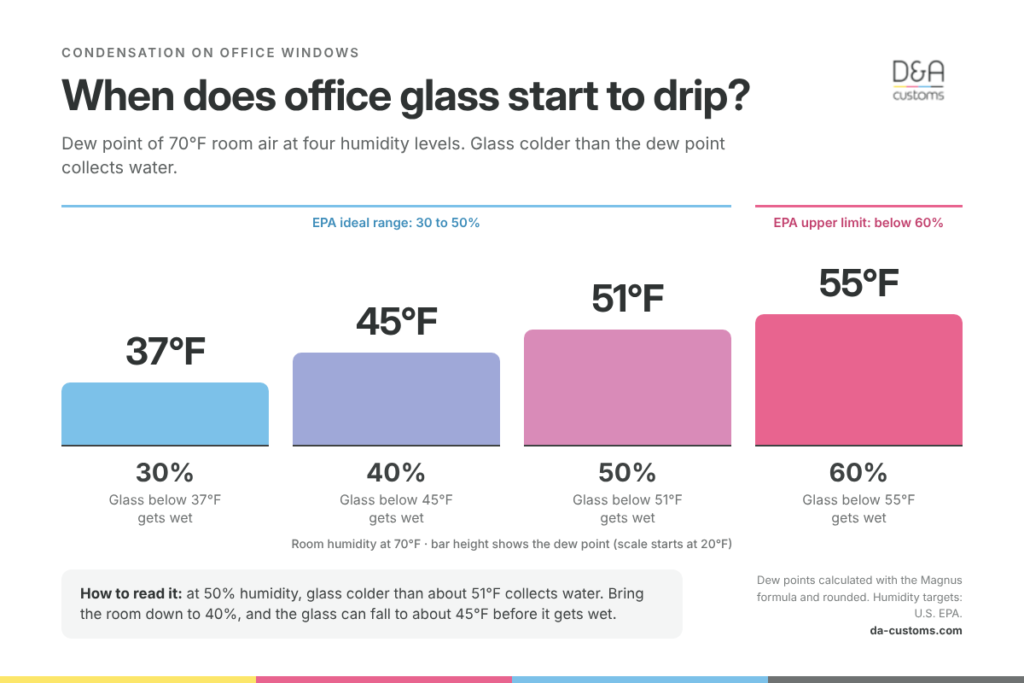
Read it this way: at 50% humidity, any glass colder than about 51°F will collect water. Bring the room down to 40%, and the glass can fall to about 45°F before it gets wet.
The type of glass sets the other number. A digest from the National Research Council Canada worked out inside glass temperatures for a 70°F room. At 40°F outside with a 15 mph wind, close to a Seattle November night, clear single pane glass sat at about 47°F. Clear double pane glass sat at about 59°F.
Put those readings next to the table. The single pane glass starts to drip once room humidity passes about 44%, a level many busy offices reach. The double pane glass holds out until about 68%. At 0°F outside, a test far colder than a Seattle winter, the same digest puts single pane glass at 17°F and double pane at 45°F.
These figures are for clear, uncoated glass, which we still find in many older office buildings around Puget Sound. That gap explains why single pane walls, often in metal frames, are the first to sweat each fall.
Before anyone pays for a fix, find out which surface is wet. Water on glass sits in one of three places, and each one points to a different cause. Run a dry finger across the glass from the room side. If the water wipes off, it is on your side; if it does not, it is between the panes or outside.
Only the room-side case comes down to humidity and room conditions. It is also the only case where window film comes into the decision at all.
Two look-alikes are worth ruling out. New film can look hazy for a few weeks while the water under it dries out. We cover this in Can You Install Window Film in Winter? Bubbles or a purple tint on old film come from film failure, which we explain in Why Does Window Film Turn Purple or Start Bubbling?.
Low-E film, such as 3M Thinsulate Climate Control, is a thin coated film applied to the room side of the glass. It reflects room heat back inside, so less of it soaks into the glass and escapes outdoors. People at desks near the window feel warmer, and the building loses less heat. The trade-off is that the glass itself now gets less heat from the room, so its surface runs a little colder.
Glass makers see the same effect with their own coatings. Guardian Glass explains that a low-E coating on the room-facing surface sends heat back into the room. That leaves the inner glass cooler, so water can form on it sooner. A coating sealed inside a double pane unit works the other way. An Ontario Hydro test put the coating inside the air gap of a double pane window. Its inside surface ran about 1.1°C warmer than a standard unit.
3M states the limit plainly in its product bulletin for Thinsulate Climate Control 75. The film keeps the glass surface colder where it is applied. In humid spots like pools, bathrooms or near kitchen sinks, 3M says to expect much more condensation than before the film went on. Its advice for any window that already drips is direct: “If the window currently gets condensation, it is not recommended to apply Thinsulate.”
Independent research shows the same pattern. A 2015 report for New Zealand’s Energy Efficiency and Conservation Authority modeled low-E film on single pane windows. The model used temperature and humidity measured in real homes. The film cut heat loss through the glass by about 20%. It also lowered the inside glass temperature by about 0.5°C, roughly 1°F, and condensation formed about 50% more often and lasted about 50% longer.
That study covered homes with single glazing, not offices. The lesson still carries over to an office wall of single pane glass in a damp room. A drop of one degree sounds small. Still, a window that sits one degree above its dew point today will cross it once the film goes on.
As a 3M dealer, we follow 3M’s limits, including the ones that cost us a job. On dry walls in offices with normal humidity, low-E film still does its job: less heat loss and warmer seats by the glass. We cover that side in Why the Desk by the Window Is Always Cold. We also check every pane before we film it, for the reasons in Can Window Film Break Your Windows?. We have found no source showing that solar control films reduce condensation, so we do not sell them for that.
The EPA’s mold guide for schools and commercial buildings gives two ways to prevent condensation: raise the surface temperature or lower the moisture in the air. To warm a surface, it says to insulate or increase air circulation. To dry the air, it says to repair leaks, ventilate when outdoor air is cold and dry, or dehumidify. It also sets a target of indoor humidity below 60%, ideally 30 to 50%.
In an office building, those rules turn into a short list of jobs:
Most room-side drips stop once humidity and air flow are under control. For single pane walls that still drip all winter, the lasting fix is warmer glass, such as new double pane units. That is glazier work, and we will tell you when a wall needs it.
A note for Puget Sound buildings: our outdoor air is damp, with morning humidity around 84% and afternoon humidity around 74% in November. Cold air still holds very little water, though. By our calculation, 41°F air at 84% humidity drops to about 33% once it is heated to 70°F. That is why fresh air from the ventilation system still dries out an office in November, even on a rainy day.
You can sort most walls in your building with three tools: a hygrometer, an infrared thermometer and the dew point table above. A basic hygrometer reads room humidity and temperature. An infrared thermometer reads the glass without touching it. Do the check early in the morning, when the glass is coldest and before the sun reaches it.
That marked plan tells you which walls need ventilation work, which need a glazier and which can take film. It also gives your HVAC contractor something concrete to work from.
If your windows drip this winter, we can do this check with you. We read humidity and glass temperature wall by wall, then tell you which walls can take low-E film, which cannot, and which need a glazier. Some of those answers will not involve us at all, and we will say so.
Contact DA Customs to book a free winter glass check.