
When winter sun glare hits an office, the first request we often hear is for the darkest film available. In Seattle, that is usually the wrong choice. Dark film cuts glare on the few sunny mornings. It also takes daylight on every gray day, blocks free winter heat and puts more stress on cold glass.
This article walks through each trade-off with 3M and industry data. It also shows how we pick a lighter film that still solves the glare.
Winter glare comes from the angle of the sun, even though the sun is weaker than in summer. According to KIRO 7 Weather, the Seattle noon sun reaches about 66 degrees in June. In late December, it reaches only about 19 degrees. Low sun shines straight through the glass and across desks, so people at the window get it in their eyes.
The problem lasts for a few months, and so does the gray weather. KIRO 7 calls December and January “The Big Dark.” The region gets the least solar energy of the year then, and many days are cloudy or foggy. Any film you choose for glare has to work through both kinds of days. That is where dark film runs into trouble.
Window film glare numbers measure lost daylight. The IWFA’s 2026 Advanced Solar Control Education Guide explains how glare reduction is measured. It compares the visible light through filmed glass with the light through plain clear glass. A film that cuts more glare always lets in less light, on sunny days and gray ones alike.
The graphic below compares three 3M Prestige films on 1/4-inch clear single-pane glass, using the 3M Prestige Series data sheet. The last column is the light-to-heat ratio. A higher number means more daylight comes in for each unit of solar heat.
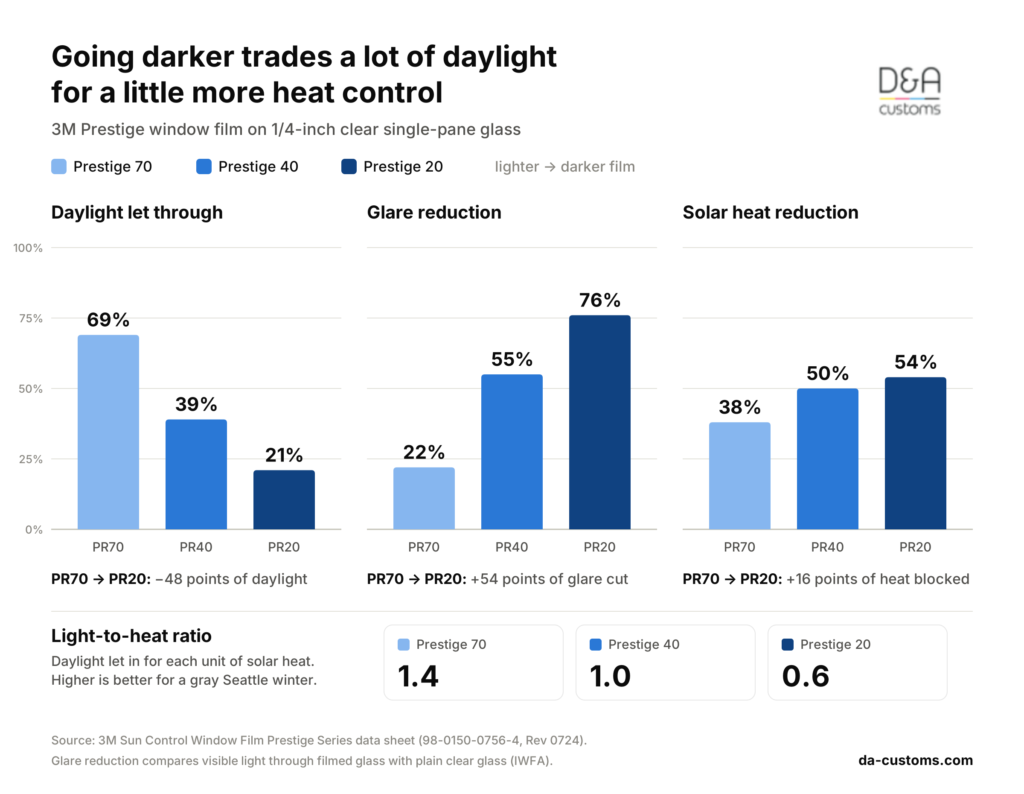
Moving from Prestige 70 to Prestige 20 cuts daylight from 69% to 21%. Solar heat reduction only rises from 38% to 54% over the same step. In a gray Seattle winter, a dark film keeps the room dim all day to fix glare on a handful of mornings, so people turn the lights on. For more on these spec terms, see what window film spec numbers actually mean.
Sun through the glass in winter warms the building for free. The IWFA guide calls this passive solar gain and explains that films which cut solar heat also cut that winter benefit. In its example, cutting solar heat lowers yearly energy costs in Phoenix. In a heating climate like Boston, it may bring a modest increase.
The guide also says the answer depends on the building. Peak demand charges, electricity and fuel prices, and uneven sun on different sides can make solar control worth it even in a cool climate. For that reason, the IWFA recommends an energy analysis of each commercial building before a film upgrade. For large buildings, it suggests asking the film maker about one.
For winter glare, a light film cuts the glare and keeps more of the free heat. A dark film gives up more of that heat for every point of glare it removes. If people at the window are cold rather than squinting, the fix is different. We cover it in why the desk by the window is always cold.
Glass cracks from heat when one part of a pane gets much hotter than another. The IWFA guide describes the classic case: glass cools overnight, then the morning sun heats the center while the edge under the frame stays cold. A cold, sunny winter morning on south-facing glass creates exactly that setup.
Film raises or lowers that risk depending on how much heat it holds in the glass. The IWFA guide names solar absorption as often the biggest factor in picking a film for a window. It warns against the darkest high-absorbing films on many glass types. It also says any glass except tempered glass can crack if the wrong film goes on, and double-pane units need extra care.
Darker film generally holds more heat in the glass, so a dark winter choice can add risk on top of lost daylight. We cover the details in can window film break your windows. The short version: glass type comes first, and the shade of film comes second.
Dark film still has a place in rooms that care more about screens than daylight. Training rooms with projectors, control rooms and edit suites often need the light cut further. The people in them may also prefer a dimmer room. For those spaces, a darker Prestige shade can be the right call if the glass checks out.
We choose room by room instead of putting one dark film across the whole building. A lobby, a row of perimeter desks and a projector room can each get a different shade. Blinds still help for the worst hour of the day. Rooms that need full blackout are better served by blinds.
Our goal is the lightest film that solves the glare. We follow the same order on every winter glare project, and the first step is always the glass. The list below shows that order.
This order keeps daylight and free heat in most of the building. It also keeps dark film off glass that cannot handle it. For larger buildings, we can ask 3M about an energy analysis before the project starts.
D&A Customs is a certified 3M window film dealer with locations in Tukwila and Bellevue. We offer a free winter glare check for offices in Seattle, Bellevue, Redmond and Tukwila. We look at the glass, the problem desks and the rooms that need the most light control. Then we recommend the lightest 3M film that fixes the glare, and we tell you where a darker shade is safe.
Book your free glare check or call 425 633 6288.
Birds fly into windows because they cannot see glass. Clear glass looks like open air, and shiny glass looks like more sky and trees. Most of these deaths happen at homes and mid-size buildings, and October is when Puget Sound facility teams start finding birds under their windows. Here is why it happens, what fixes it, and which windows to treat first.
Glass fools birds in two ways. Clear glass shows them the trees or plants on the other side, so they fly toward them. Shiny glass shows them a copy of the trees and sky around the building, so they fly into the copy. Either way, the bird sees no wall.
People spot glass by its frames, smudges and edges. Small songbirds see fine detail far less sharply than we do, the American Bird Conservancy (ABC) explains. A pattern that looks obvious to us may not register for a bird at all.
The same spots cause trouble on most buildings. A University of Washington study of 22 campus buildings found glass railings were the deadliest feature. It also flagged glass walkways, glass corners, and glass near plants and trees. When we survey a site, those are the first places we check.
A 2014 study in The Condor estimated that buildings kill 365 to 988 million birds a year in the U.S. About 56% of those deaths happened at buildings of 4 to 11 stories, and 44% at homes of 1 to 3 stories. High-rises of 12 stories or more caused less than 1%, according to Audubon’s summary.
Towers kill more birds per building, but there are very few of them. The U.S. has about 129 million homes and roughly 21,000 skyscrapers. That puts most of the problem on office parks, schools, clinics and homes. A two-story office next to a greenbelt is a typical site for bird strikes.
Seattle has its own numbers. Birds Connect Seattle volunteers have checked buildings for dead birds since 2021. In 2024, the group estimated that nearly 30,000 birds die at homes and campus buildings during spring and fall migration. Thrushes were the most common victims, followed by sparrows and warblers.
That early number left out offices and most of the year. In May 2026, the group told KNKX it now estimates about 80,000 deaths at Seattle homes alone during migration. Office buildings would add to that total.

One hawk sticker leaves most of the glass open. Birds see the open space as a gap between branches and try to fly through it. Markers only work when they are close enough together that the whole pane looks solid. UW’s standards ban hawk images and decoys for this reason.
The spacing rule has gotten tighter. ABC used to recommend markers 2 inches apart one way and 4 inches apart the other. Later tests showed 4-inch gaps did not stop the smallest birds, such as hummingbirds. ABC now recommends a “2×2 rule”: no more than 2 inches between markers in any direction.
A pattern that works has to meet a few basic rules. This short checklist is based on ABC and UW guidance:
If a quote skips any of these, ask why. One row of dots at eye level helps people, but birds need the full grid.
You may also see a “Threat Factor” score on bird-safe products. ABC tests each pattern with wild birds in a flight tunnel, and a lower score is better. A score of 30 or less counts as bird-friendly. UW warns that the test can overstate real results, so we use the score as a first filter, then check spacing and placement.
Fixing existing glass works. In October 2023, nearly 1,000 birds died in one night at a Chicago convention center, AP reported. The next year, the building added film with small white dots two inches apart. After that fall’s migration, collisions had dropped by more than 95%.
Glass reflects at its outer surface. If markers sit on the inside, that reflection can hide them for much of the day, ABC notes. Dots that look fine from your desk can vanish for a bird outside on a bright morning. That is why UW requires all bird patterns on the outside face of the glass.
Some common fixes fall short in Seattle. UW bans UV-only patterns, which birds see less well under gray skies. It also rules out indoor blinds and shades as a bird fix. Outdoor patterns have to survive rain, window washing and sun, so the material matters.
This work is close to what we already do. Our team designs, cuts and installs vinyl patterns on storefront and office glass across Seattle, Bellevue and Tukwila. Bird patterns use the same layout work, with outdoor-rated material and a tighter grid.
Most buildings don’t need to treat every pane at once. UW’s standards say that treating the worst spots first can prevent many collisions. This is the order we follow on a site survey:
Start with the first two groups, since that is usually where the problem shows up. Then work down the list as the budget allows.
Turning off lights is a free first step. Birds that migrate at night use the stars, and bright buildings confuse them, the AP reported. Lights Out campaigns suggest switching off unneeded lights from 11 p.m. to 6 a.m. during migration, per KNKX. Ask your cleaning crew to close blinds and turn off perimeter lights each night.
The walls that kill birds often overheat in summer too. Mirror-style sun control films cut heat by reflecting light, and that shows birds even more sky and trees. On those walls, the wrong film makes the bird problem worse. We explain how mirror films work in Why Do Some Buildings Look Like Mirrors?
For bird-risk walls that need heat control, we use 3M Prestige. It contains no metal and is designed to keep reflection low, 3M says. On clear single-pane glass, Prestige 70 reflects only 9% of visible light outward, per 3M’s data sheet. It still lets in 69% of daylight while blocking half of the sun’s total energy.
Prestige is a heat and UV film. 3M does not sell it as a bird product, and we don’t either. Its job is to cut heat without making the building shinier. The bird pattern goes outside, and the Prestige goes inside.
Two products on one pane need a quick check first. As a certified 3M dealer, we confirm the glass type and 3M’s guidance before we quote. Film changes how much heat glass holds, which we cover in Can Window Film Break Your Windows?
People markers and bird markers do different jobs. The round markers and glass awareness stickers we install for code sit in bands at about 30 and 60 inches. Birds need a 2-inch grid across the whole pane. Spring migration peaks from mid-April through May, so winter is a good time to plan.
We offer a free bird-strike glass survey for commercial buildings in Seattle, Bellevue, Tukwila, Renton and Kirkland. We find the walls where birds hit, design an outdoor pattern that follows the 2-inch rule, and match it with any heat-control film on the same glass. Contact us to book a walk-through.
Glass can break in an earthquake even if nothing touches it. The building sways, the window frames bend, and the glass gets squeezed until it cracks. In an office, these are often the panes people sit next to every day: conference room walls, glass partitions, and tall lobby windows. Here is why it happens, which glass to worry about, and what window film can do.
The 2026 Great Washington ShakeOut drill runs on Thursday, October 15, at 10:15 a.m. Organizers ask people to drop, cover, and hold on, then do one more thing to get ready. For offices and schools, we suggest that one more thing be a quick look at the glass.
On February 28, 2001, a magnitude 6.8 earthquake hit the Puget Sound region. The Pacific Northwest Seismic Network (PNSN) says it caused about $2 billion in damage and injured 400 people. Most modern buildings stayed up, but broken windows, fallen ceilings, and damaged pipes disrupted work at Starbucks, Boeing, Amazon, and government offices. PNSN found that this kind of damage, plus lost business, made up most of the cost.
Quakes like Nisqually hit this region about every 30 years. PNSN puts the chance of another one above magnitude 6.0 at 84% in the next 50 years. The state’s ShakeOut organizers add that Washington has the second-highest earthquake risk in the U.S., after California.
In an earthquake, each floor of a building moves a little differently from the floor below. Window frames are attached to both floors, so they lean out of square. The glass inside can’t bend. If the frame leaves no room around the edges, it presses on the glass until it cracks.
The International Window Film Association (IWFA) calls this a racking motion and says it often breaks glass and makes it fall out. FEMA’s earthquake guide (E-74) agrees that glass is most at risk when its frame leaves too little space around it. Nothing has to hit the window. The building’s own movement does the damage.
This is a different kind of break from a rock or a hammer. We explain how film holds glass after a hit in Can a Thin Sheet of Film Really Stop Glass From Flying Everywhere?. In an earthquake, the force comes from the frame, and it keeps coming. The Nisqually shaking lasted more than 30 seconds.
FEMA warns that broken glass walls can drop glass on people and block hallways while everyone is trying to get out. When we walk an office, these are the spots we check first:
If your office has any of these, start there. That is also where film makes the biggest difference.
Glass type matters too. Older walls and windows often use plain glass that breaks into big, sharp pieces. Tempered glass breaks into small, blunt bits, but those bits still fall out of the frame. We compare glass types and films in Security Film vs. Standard Window Tint.
Many installers talk mostly about film thickness. In an earthquake, the bigger question is whether the cracked pane stays in its frame. Film on its own keeps the broken pieces stuck together, but the whole sheet can still slide out of a bent frame.
A 2004 Penn State study tested this. Researchers shook filmed glass in simulated earthquakes and tried three ways of anchoring the film to the frame. The type of anchor changed how soon the glass cracked and whether it fell out. In some tests, whole filmed panes pulled out of their frames.
That is why we recommend anchoring the film to the frame on high-risk glass. 3M makes Impact Protection Attachment (IPA) Sealant for this job and lists earthquakes among its uses. We usually pair it with 3M Scotchshield Safety & Security Ultra film. Some low bids skip the sealant to save money, so ask about it when you compare quotes.
Film helps, but it has limits, and we would rather you know them up front. Here is what it will not do:
What film does well is keep broken glass in place and off the hallway floor. With an attachment, it also helps keep the cracked pane in its frame until someone can replace it.
After the drill, take 20 minutes to walk your floor with a phone. You don’t need any tools. Write down or photograph:
This list shows which glass to fix first, and it gives any installer something specific to quote. Safety markers on glass walls help people see the glass, but they add no strength. We cover them in Distraction Markers for Clear Glass.
If you’d like help with your list, we’ll walk the floor with you for free. We work with offices, schools, and clinics in Seattle, Bellevue, Tukwila, and Renton. We check the glass type, the frames, and which openings need film plus attachment. As a certified 3M dealer, we install both to 3M’s specifications.
Contact D&A Customs to book a time, or read more about our Safety and Security Window Film service. Schools can also see our School Safety page and our guide to federal grants for school safety film.
When a phone drops to one bar next to the office windows, the glass is usually the reason. Modern energy-saving glass carries a thin metal coating, and metal blocks radio signals. In most buildings, the glass was cutting the signal long before anyone mentioned window film. Film can add to the problem or stay out of it, depending on how the film is built.
This article explains how the glass does it and how much signal it takes. It names which 3M films are metal-free and which ones are not, including the insulating film we recommended two weeks ago. It also covers what to do if your building already has dead corners.
Energy-saving glass, often called low-E glass, has a coating you cannot see. The coating is a stack of very thin layers, and at least one of them is metal, usually silver. A 2023 review in the Journal of Building Engineering puts that metal layer at about 10 to 20 nanometers thick. The same review says silver-based coatings make up more than 90% of the low-E market.
The metal is what makes the glass efficient. It reflects heat back toward where it came from, which keeps offices cooler in summer and warmer in winter. The catch is that metal also reflects the radio signals phones depend on. The review lists cell networks, GPS and Wi-Fi among the signals that lose strength passing through low-E glass.
Your office Wi-Fi mostly stays indoors, so the glass rarely gets in its way. Cell signal is different. It has to travel from a tower outside, through the building’s skin, to the phone at your desk. The review also notes that higher-frequency 5G signals travel shorter distances and lose strength more easily passing through building materials.
Engineers measure signal loss in decibels, or dB. The scale does not work like a ruler. Every 10 dB cuts the signal to one-tenth of its strength, so 20 dB leaves one-hundredth and 30 dB leaves one-thousandth.
A team of Swedish engineers measured this on real window panes for a 2019 paper in IEEE Transactions on Electromagnetic Compatibility. They tested glass from different generations across 1 to 18 GHz, a range that covers many phone and Wi-Fi bands. Here is what they found for single panes:
| Glass type | Measured signal loss |
|---|---|
| Plain clear glass, no coating | A couple of dB at most |
| Hard-coated low-E glass | About 20 dB |
| Low-E glass with one silver layer | About 25 dB |
| Low-E glass with two silver layers | About 35 dB |
A 25 dB loss leaves less than 1% of the signal. Other studies land in the same range. One study cited in the 2023 review found low-E glass cut signal by an average of 30 dB between 800 MHz and 6 GHz. Another found a double-pane low-E window cut a 3.5 GHz signal by 25 dB, about the same as a 2 mm aluminum plate.
Whether that loss means one bar or no bars depends on how strong the signal is outside. A desk on the side facing a nearby tower may still get a usable signal. A corner conference room on the far side of the building may not. The review puts typical signal loss through a whole building at around 5 to 15 dB, and says metal-coated glass pushes that number higher.
The same 2019 study tested complete window units, not just single panes. Older energy-saving windows built from two or three plain panes cut signal by only a few dB. The most modern units averaged 20 to 30 dB and reached 50 to 60 dB at the upper end of the tested range. The authors sum it up in one line: the more modern the window, the more signal it blocks.
They also mention a reported case where a building blocked more signal after part of a brick wall was removed and a modern window went in. That surprises most people, since glass looks open and brick looks solid. What stops a radio signal is metal, and a modern window carries a metal layer.
The glass-heavy offices around South Lake Union, downtown Bellevue and the Eastside corridor are exactly the buildings this research describes. In buildings like these, a dead corner often exists on move-in day, before any film goes up. That matters when someone proposes film and the IT team asks whether it will kill the signal.

Window film goes on the inside face of the glass, directly in the path the signal travels. A film with no metal in it adds no metal layer to that path. A metallized film adds one more metal layer the signal has to cross. Researchers who tested 57 window systems found that signal loss climbed sharply as metal layers were added, according to the 2023 review.
We have not seen 3M publish a signal-loss figure for its metallized films, so we do not quote one. What we can tell you is which films contain metal and which do not. That is the question that decides the risk.
3M makes films in both families. Its product literature says so plainly, which makes the check easy. Here is how the films we quote most often break down:
| 3M film | Metal in the film? | What 3M says |
|---|---|---|
| Prestige Series | No | Non-metallized multilayer film that won’t affect signal |
| Ceramic Architectural Series | No | Non-metallized film that won’t corrode or interfere with broadband signals |
| Night Vision Series | Yes | Product bulletin lists the base as metallized PET |
| Thinsulate Climate Control | Yes | Spec sheet describes a metallized polyester film |
Prestige and Ceramic are our default for any tenant that lives on phones and video calls. Prestige still rejects up to 97% of the sun’s infrared light and up to 60% of the heat coming through the window, by 3M’s numbers. Our guide to window film spec numbers explains why those two figures differ.
To check any quote, ask for the manufacturer’s product bulletin for each film. 3M bulletins list the construction on a line called material base. If that line says metallized, you know what you are buying.
Two weeks ago we recommended 3M Thinsulate Climate Control for cold perimeter offices. 3M’s spec sheet describes it as an optically clear metallized polyester film with a metal coating. That metal layer gives the film its low-E performance. It is also the property that can reduce radio signal, the same way low-E glass does.
The trade-off lands in a specific place. Thinsulate helps most on older single-pane and plain double-pane glass. That same plain glass lets signal through almost untouched today. Adding the film puts a metal layer on glass that had none.
We decide this wall by wall. A cold north wall of open desks where people rarely take calls may be worth it. A glass conference room where the team runs video calls all day may be better served by Prestige, with less winter gain. We put that choice in front of you in writing, and you make it with the numbers in hand.
If a floor already has dead spots, film is rarely the cause and never the cure. The fix sits with the glass, the carrier or an in-building system. Here is the order we suggest:
Steps 1 and 2 cost nothing and settle most of the argument about who is responsible. Bring the readings to your IT team and your carrier before anyone spends money.
A signal-sensitive building needs a film spec that states construction, not just performance. Most bids leave it out because nobody asks. Five questions close that gap:
For an RFP, two lines cover it. Sun control film on the listed walls shall be of non-metallized construction. The bidder shall submit the manufacturer’s product bulletin confirming the material base. A certified 3M dealer quotes from those bulletins and knows the construction of every film it installs. We put it on every quote.
We run free spec reviews for offices in Seattle, Bellevue, Tukwila, Renton and across the Puget Sound area. We identify the existing glass on each wall and tell you whether film would add to a signal problem or has nothing to do with it. Then we put the film construction for every wall in writing before anything goes on the glass.
Already holding quotes from other installers? Send them over, and we will tell you which films in each one contain metal. Contact D&A Customs to book the review, or see what a commercial window tinting project involves.
Put three commercial window film quotes side by side, and the heat numbers rarely match. One says the film blocks 97% of the heat. Another says 60%. Most people would rank the 97% bid first, and that can be the wrong call.
Those two numbers can describe the same film. 3M publishes both for its Prestige Series: up to 97% of the sun’s infrared light and up to 60% of the heat coming through the window. Neither number is false. They measure different things, and once you know what each one measures, ranking bids gets simple.
This guide explains the four numbers on every spec sheet and settles the TSER vs IR rejection question. It also covers the one line on a data sheet almost nobody reads. It ends with five questions you can put to any bidder in Seattle, Bellevue, or anywhere else.
Sunlight carries its energy in three bands. The International Window Film Association (IWFA) puts the split at roughly 44% visible light, 53% infrared, and 3% ultraviolet in its solar control education guide. Every number on a film spec sheet describes what happens to some or all of that energy. The trouble starts when a quote uses a number about one band as if it covered all three.
Visible light transmission (VLT) is the share of daylight that gets through the glass and film. Higher VLT means a brighter room. Visible light also carries 44% of the sun’s energy, and it turns into heat when it lands on desks and floors. A clear film lets most of that energy in, because keeping the daylight is the whole point.
Infrared (IR) rejection is the share of infrared light a film blocks inside the band it was tested on. Infrared is the heat you feel on your skin near a sunny window, and it carries about 53% of solar energy. A high IR number is real. It says nothing about the other 47%, and it depends on which part of the infrared band was measured.
Total solar energy rejected (TSER) is the share of all incoming solar energy that stays outside, across ultraviolet, visible, and infrared together. This is the number that tells you how the room will feel on a sunny afternoon. The IWFA guide defines it as one minus the SHGC, shown as a percentage. It measures film and glass together, so the glass under the film changes it.
The solar heat gain coefficient (SHGC) is the fraction of solar energy that ends up inside as heat. It runs from 0 to 1, and lower is better, so a film with 50% TSER has an SHGC of 0.50. The IWFA guide says comfort and cost savings in commercial buildings depend mostly on SHGC. It is also the number any payback estimate should start from, and our payback breakdown for Seattle and Bellevue office buildings covers the other inputs.
| Number | What it measures | Better when | Use it for |
|---|---|---|---|
| VLT | Daylight that gets through | Higher, if you want a bright room | Judging how the room will look |
| IR rejection | Infrared blocked, inside the tested band only | Higher | Comparing films tested on the same band |
| TSER | All solar energy kept out | Higher | Ranking heat performance |
| SHGC | Solar energy that ends up inside as heat | Lower | Energy models and engineering |
Rank bids on TSER or SHGC. Use VLT to judge how the room will look, and treat IR rejection as a supporting detail.
It is the biggest number on the sheet, and it is true. Spectrally selective films are built to block infrared while letting daylight through, so they post high IR numbers. A 97% looks better on a proposal than a 50%, even when both describe the same film. On most competing quotes property managers send us, the IR figure is the largest number on the page.
The IWFA guide itself calls IR rejection percentages problematic. The infrared band is wide, and the sun’s strength shifts from one wavelength to the next, so one percentage can hide a big spread. It also leaves out visible light, which a clear film lets in by design. A room can still warm up under a film with a high IR number.
3M’s own data shows how little the IR headline predicts. The product pages list up to 97% IR rejection for Prestige and up to 61% for the Ceramic Architectural Series. On the data sheets, both on single-pane clear glass with about 60% daylight, Prestige 60 rejects 53% of total solar energy and Ceramic 60 rejects 48%. The IR headlines are 36 points apart, and the TSER numbers are 5 points apart.
We have used both Prestige numbers ourselves, including in our article on why west-facing offices in Seattle and Bellevue overheat by 3 PM. Both figures are accurate. This page explains which one to use for what.
The footnote explains most of it. On 3M’s Prestige page, the 97% carries a note: IR rejection measured from 900 to 1,000 nanometers. The IWFA guide puts near infrared at 780 to 2,500 nanometers. So the 97% describes a narrow slice of the infrared band, and 3M says so on the page.
The 60% is a different kind of number. It is TSER, the whole spectrum, and “up to” covers the range of shades in the line. The Prestige data sheet gives each shade’s exact result. On quarter-inch single-pane clear glass, TSER runs from 50% for Prestige 70 to 62% for Prestige 20, the darkest shade.
Here is what one film on one window can look like on paper. Every figure below comes from 3M, and the last three rows are for Prestige 70 on quarter-inch double-pane clear glass.
| What a quote might say | Figure | What it actually measures |
|---|---|---|
| Infrared rejection | Up to 97% | Prestige Series headline, infrared from 900 to 1,000 nm only |
| Heat rejection | Up to 60% | Prestige Series headline for total solar energy |
| TSER, sun straight on | 44% | Prestige 70 on double-pane clear glass |
| TSER, sun at 60 degrees | 50% | Same film and glass, sun at an angle |
| Solar heat reduction | 21% | How much less solar heat gets in than through the same glass with no film |
Every row is accurate, and a bidder can put any of them on a proposal. Only the last three describe that window, and only if your building has double-pane clear glass.
A real number is one you can check. 3M states its IR band in a footnote, so its 97% is checkable, narrow as it is. The problem is the quote that lists an IR percentage with no band at all. You cannot compare it with anything, so leave it out of the ranking.
The test standard matters as much as the band. The IWFA guide recommends measuring and reporting film performance with National Fenestration Rating Council (NFRC) procedures. It also notes that different standards use different solar spectrums, with at least three in use around the world. Two numbers from two standards are not a fair comparison.
Sun angle is the third check. Standard spec sheet values assume the sun hits the glass straight on, according to the IWFA guide. 3M’s Prestige sheet lists TSER both ways: Prestige 70 on single-pane clear glass reads 50% straight on and 59% at a 60-degree angle. A bid that quotes the angled figure beats a straight-on bid by 9 points on paper, with the same film.
For every number on a quote, ask for four things: the metric, the band if it is IR, the test standard and the sun angle. A bidder quoting from a manufacturer’s data sheet can answer all four in one email.
Every film number is a result for film and glass together. The IWFA guide says data sheets should always state the glass type and thickness behind each value. Most readers skip that line. On 3M’s own Prestige sheet, the glass moves TSER more than the choice of shade does.
Here is Prestige 70 on four kinds of quarter-inch glass, straight from 3M’s data sheet.
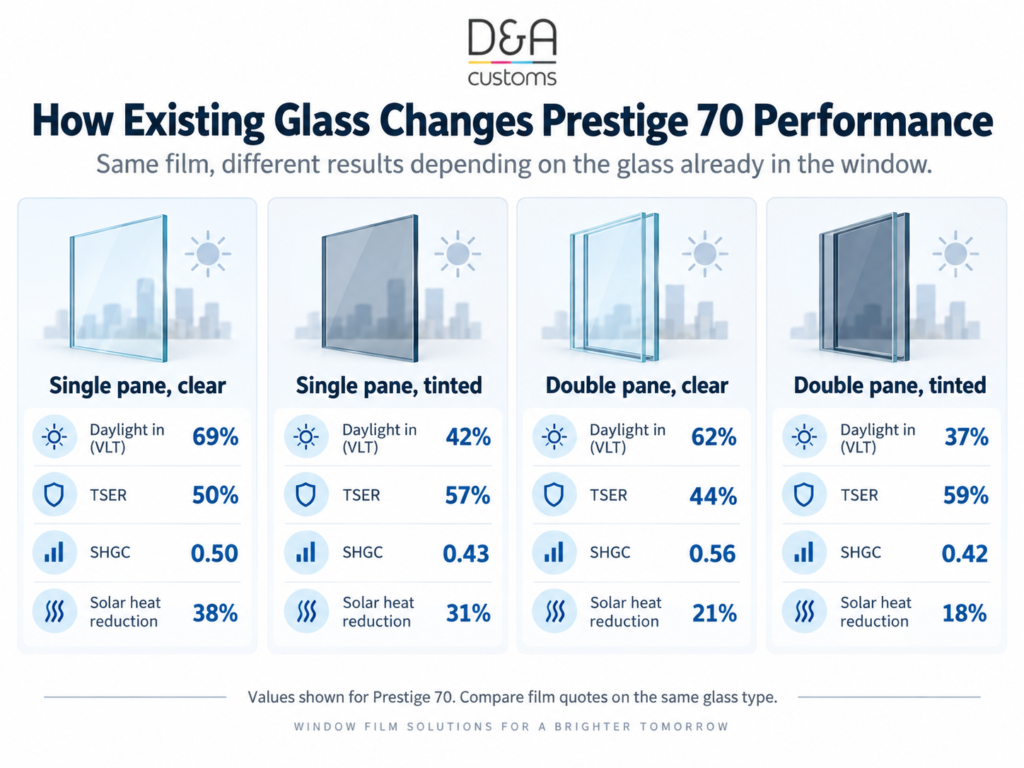
The same film ranges from 44% to 59% TSER. Look at the bottom row: it has the highest TSER and the smallest improvement, because tinted double-pane glass was already blocking heat before any film went on. A bid that quotes that row for a building with double-pane clear glass overstates TSER by 15 points.
Older buildings with repairs or partial replacements can carry more than one glass type, so ask which row applies to each wall. The sheet has no row at all for low-E glass. If your building has it, ask for numbers calculated on your actual glass, plus the film-to-glass check we describe in Can Window Film Break Your Windows?
Darker film blocks more total solar energy, and it also blocks daylight. On single-pane clear glass, Prestige 20 rejects 62% of solar energy and lets in 21% of daylight. Prestige 70 rejects 50% and lets in 69%. Twelve more points of heat rejection cost 48 points of daylight.
The IWFA guide measures this trade with the light-to-solar-gain ratio (LSG), which is VLT divided by SHGC. A score over 1.00 counts as spectrally selective, meaning the glass lets in more light than solar heat. On 3M’s sheet, Prestige 70 scores 1.4 on single-pane clear glass and Prestige 20 scores 0.6. That gap is why we rarely start with the darkest shade in an occupied office.
We pick the lower TSER without much debate in three situations:
A lower TSER on the right wall is a deliberate choice, and a good bid explains it in writing. Where peak heat on west glass is the real problem, film cuts the load on the cooling system, which we compare with equipment upgrades in HVAC vs. 3M commercial window film. For cold perimeter desks in winter, a different film does the job, covered in why the desk by the window is always cold.
Take these to every bidder, including us. A good bidder answers all five in one reply, with the manufacturer’s data sheet attached. If three quotes are sitting on your desk this month, this is the fastest way to compare window film quotes line by line.
Once all three bids answer these five questions, you are comparing the same thing three times. Put SHGC on your glass side by side, check the daylight, and compare price last.
Send us the film quotes you already have, from any installer. We will read each one against your actual glass and tell you what each bid actually offers. You also get a list of what is missing from each spec, whether or not you end up hiring us.
We are a 3M certified window film dealer serving Seattle, Bellevue, Tukwila, Renton, and the rest of Puget Sound. If you are setting a Q4 budget, send the quotes before anyone signs. Contact D&A Customs to start the review.
From October to March, this is the most common complaint in a glass-heavy office. The thermostat reads 72. The person at the window desk is still cold, and changing the setpoint does nothing.
The cold is coming off the glass itself. Your body sends heat toward that cold surface all day, and a thermostat has no way to measure it. Here is how that works, what a low-E window film changes on each type of glass, and where we will not install one.
Warm things send heat to cold things near them. You are warm. In winter the inside face of a window is the coldest surface in the room, usually by a wide margin.
Researchers at Lawrence Berkeley National Laboratory studied this for the U.S. Department of Energy. Their paper on window performance and human thermal comfort names three things that happen in winter. Your body gives off heat toward the cold glass. Cold air slides down the pane and moves through the room. And the side of you facing the window stays colder than the side facing the room. People who sit still feel all three the most.
Their example is the one every facility manager should see. A person sits about three feet from a full-height window. The room air holds at 70°F. The glass is standard clear double pane, and its inside face reads 45.3°F. Everything else in the room is at room temperature. The temperature that person’s body registers is 53.4°F.
That gap is the complaint. The room is at 70 and the person is living at 53. The study used a test condition of 0°F outside, which is colder than Seattle gets, so your gap will be smaller. The pattern repeats on every cold morning anyway.
Here is what the inside face of the glass reads under those same test conditions:
| Glass in the opening | Inside surface temperature |
|---|---|
| Single pane, clear | 16.9°F |
| Double pane, clear | 45.3°F |
| Double pane, low-E coating | 54.3°F to 57.2°F |
| Triple pane, low-E | 63.7°F |
Read the table as a comfort scale. The colder the inside of your glass, the more heat the person beside it gives up. You can check your own glass with an infrared thermometer. The survey steps near the end of this article show how, and this table tells you what the reading means.
Cold glass chills the thin layer of air touching it. That air gets heavier, slides down the pane, spreads across the floor and moves past people’s ankles. Nothing is leaking. A perfectly sealed window still does this.
The same study found the draft is the smaller half of the problem. Moving air accounted for no more than about 10% of the complaints in their winter models. The authors write that people often mistake heat loss toward cold glass for a draft, or feel real air movement caused by worn weather stripping.
This is where money gets wasted. Teams re-caulk the frames, put a space heater under the desk, or rebalance an air vent. The complaint comes back every winter. The fix has to make the glass warmer.
The complaint follows the glass. Interior offices almost never produce one. Two things drive it: how much glass a person sits in front of, and how long they sit still.
Someone in the middle of a floor is surrounded by surfaces at room temperature. Someone at a window wall has a large cold surface right in front of them. LBNL modeled that exact case, with glass across the whole outside wall and the person three feet away.
Sitting still makes it worse, and the study says so directly. A person typing at a desk makes very little body heat and gives up more than they produce. Corner offices and glass conference rooms have both problems at once, which is why they show up first on the list.
The LBNL paper puts the commercial cost plainly: in commercial buildings these problems make the space less attractive to tenants. That belongs in a leasing conversation, not only a maintenance one.
Someone touring a perimeter suite at 9 a.m. in January learns something about the building that new finishes cannot hide. The property managers we work with watch this closely. Cold seats get abandoned, desks move inward, and the tenant pays rent on space nobody uses.
A low-E film has a coating that reflects heat back into the room instead of letting it pass out through the glass. The inside of the glass stays warmer, and the person sitting there loses less heat. 3M describes its low-E films as giving insulation much like upgrading a single pane to a double pane, and a double pane to a triple pane.
The same 3M page cites the U.S. Department of Energy: nearly 40% of the heat lost from commercial buildings goes out through the windows. It also cites Cornell Cooperative Extension: a single-pane window loses 20 times as much heat as the same area of insulated wall. Glass is the weakest part of the wall, and in most Seattle offices it is also the biggest part.
What you gain depends on what is already in the opening. These are 3M’s published lab numbers for Thinsulate Climate Control 75 on clear glass:
| Existing glass | U-value before | U-value with film | Less heat lost | Daylight before | Daylight after | SHGC before | SHGC with film |
|---|---|---|---|---|---|---|---|
| Single pane, clear | 1.03 | 0.62 | 40% | 89% | 74% | 0.82 | 0.53 |
| Double pane, clear | 0.47 | 0.36 | 26% | 79% | 66% | 0.70 | 0.51 |
A lower U-value means less heat escapes in winter. A lower SHGC means less of the sun’s heat comes in during summer. 3M lists these as lab values, so treat them as a guide to what your building can gain.
Two things stand out. Single-pane buildings gain the most, which is why older Pioneer Square and Georgetown stock responds so well. The film also keeps most of the daylight, so nobody has to solve the problem by closing the blinds, which we covered in window film vs. blinds. It works in both seasons on the same glass. Our payback breakdown for Seattle and Bellevue office buildings shows how that math runs, and the HVAC comparison covers the cooling side.
Film makes the glass warmer. It does nothing about the other three causes of a cold perimeter zone, and we say so on site before anyone signs.
Bring us a floor with two of these and film is still worth doing. Bring us a floor where every complaint traces back to one fogged wall of glass, and we will tell you to call a glazier first.
Most film companies publish the claims and skip the limits. 3M publishes both. Its technical bulletin for Thinsulate Climate Control 75 lists the places this film causes trouble, and we follow it.
We would rather drop two walls from a quote than leave a building with a warranty problem in March. It also means the answer changes wall by wall instead of one product for the whole building. A west-facing wall where summer heat is the bigger problem usually gets a different 3M film, such as Prestige. The insulating film also carries that metal layer, which brings one more trade-off. We will cover it in a separate article.
You can rank your own problem walls before you call anyone. It takes one person, one afternoon and an infrared thermometer.
Take that sheet into any bid conversation and you will know which walls deserve film and which need a glazier or a mechanical contractor. It also stops a vendor from quoting a whole floor when three bays carry the problem.
This is the question every facility manager asks next, so here is the short version. Film goes on the inside face of the glass, so there is no exterior work, no lift and no glass coming out. Crews work window by window. A desk needs to be clear for a short time, then the person moves back in.
Most of our office work runs after hours or over a weekend when a floor cannot be disturbed. Plan for one thing afterward. This film dries slower than standard film, so the glass can look dimpled or hazy for a few weeks. 3M gives it about 30 days to settle and reach full adhesion. Leave the glass alone for that first month, then clean it normally.
We run a free winter comfort walk-through for commercial buildings in Seattle, Bellevue, Tukwila, Renton, and the rest of the Puget Sound area. It includes surface temperature readings on the glass and the walls, a complaint map by wall, and glass identification for every opening.
You get a written recommendation naming the walls we would film, the product for each one, and the walls we would leave alone. September is the last month with enough lead time to get film on the glass before the cold complaints start.
Contact D&A Customs to book the walk-through, or see what a commercial window tinting project involves.
Window film can contribute to a cracked pane. That is the honest answer, and it is the one most film companies skip.
The longer answer is the useful one. Glass cracks from thermal stress when one part of a pane runs much hotter than another part. Film changes how much solar energy the glass holds, so the wrong film on the wrong glass raises that risk. The right film on checked glass keeps the risk low.
This article covers how thermal stress works and how to tell a thermal crack from an impact crack by looking at it. It also covers what a compatibility check includes before anyone quotes you a price.
Glass expands when it warms. When one part of a pane warms faster than another, the warm part pushes outward and the cold part resists. That tension builds at the edge.
The International Window Film Association describes the classic case in its 2026 Safety and Security Education Guide. A cold east-facing window gets hit by sun on a clear morning. The center of the glass heats quickly.
The edges sit under the frame, stay shaded, and stay cold. The heat difference builds stress at the edge until the glass cracks. That stress has nowhere to go, so the glass gives way at its weakest point. Uneven shading does the same job. An overhang, a column, or a building across the street can leave half a pane in sun and half in shadow for an hour. One pane, two temperatures, same result.
The guide adds a distinction that competitor articles leave out. Clear safety film has little if any effect on thermal stress. Solar films are the ones that call for caution, because they change how much energy the glass absorbs.
Summer gets blamed for heat problems. For cooling loads that is fair. Thermal stress runs on difference, though, and autumn produces the sharpest differences of the year around Puget Sound. Two things change at once in September and October.
Nights get cold while days stay clear. Glass sits near the overnight low until the sun reaches it, then heats fast. A pane that spent nine hours at 45 degrees does not warm evenly when the sun lands on it. The sun also sits lower in the sky than it did in June. Low sun strikes vertical glass closer to head-on, so more of its energy lands on the window instead of the roof. Cold glass plus direct sun on one part of the pane is the exact setup the IWFA describes. Summer mornings start warmer and the sun climbs steeply overhead. The glass and its frame warm closer together, and the gap across the pane stays smaller.
Shadows shift as the sun’s path drops. A pane that sat fully shaded all summer can pick up a hard-edged strip of sun by October. The line between sun and shade is where the temperature difference is sharpest. This matters most on dense blocks in downtown Seattle, Bellevue, and Tukwila. A parking structure, a mature tree, or a taller neighbor can put a shadow across the middle of a pane for part of the morning.
We look at what sits across the street and above each window, not only at the glass. A survey run in July can miss a shadow line that only shows up in the fall.
A thermal crack has a signature, and you can check it yourself with a phone camera. The European Window Film Association published the characteristics of thermal stress fracture in float glass, and they are specific enough to rule the cause in or out.
Three things have to be true at the same time:
If a crack shows all three, thermal stress is the likely cause. If it is missing any of them, thermal stress did not cause it. The IWFA describes the same pattern in plainer terms: a short crack square to the edge that then wanders into the pane on a jagged diagonal.
An impact crack behaves differently. It starts where the object hit, which is usually out in the open part of the glass, and spreads from that point. Take one photo straight on and one close to the origin, and the difference is usually clear in a few seconds.
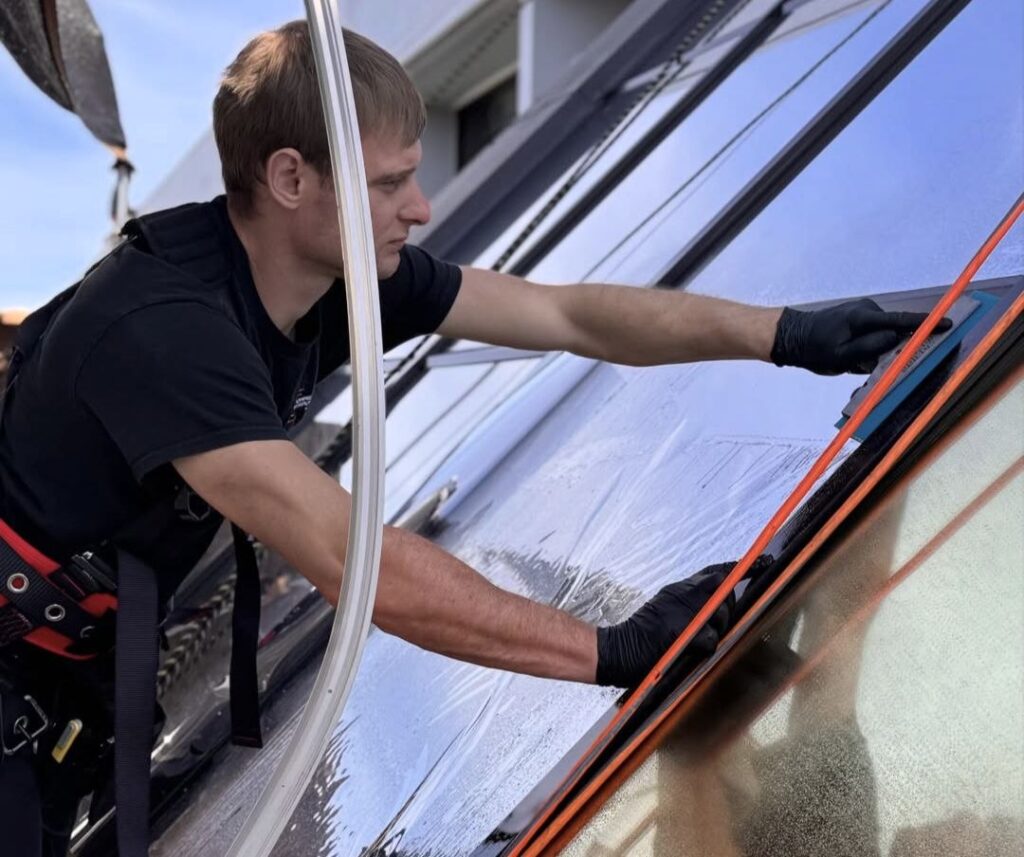
Risk is not a property of film. It comes from the combination of what the glass is, what shape it is in, what the film does with solar energy, and what shades the pane. Four factors carry most of the weight, and all four are checkable on site before anyone signs anything.
Glass type sets the ceiling on risk. The EWFA gives a clear hierarchy, and it decides how much assessment an opening needs.
| Glass type | Thermal stress exposure | What that means for film |
|---|---|---|
| Annealed, including plain float | Subject to thermal stress breakage | Always assess film-to-glass compatibility |
| Heat-strengthened | Highly unlikely to see excess thermal stress | Check conditions on that specific opening |
| Tempered | Not exposed to excess thermal stress in normal building use | Film goes on without a thermal stress assessment |
The IWFA guide notes that most glass in use today is annealed. That puts the majority of commercial openings in the top row, where the check is not optional.
Thermal cracks start at the edge, so the state of the edge decides a lot. A chip, a nick, or a rough cut gives the stress a place to begin. The EWFA notes that breakage at low thermal stress often traces back to glass that was already damaged. Most of that edge sits hidden under the frame, which is why a walk-past inspection misses it. Visible chips near the glazing line are worth flagging on your own before a bidder sees them.
We check edges and glazing seals on site as part of the survey. A pane with damage at the edge changes what we are willing to spec on that opening.
Film does three things with solar energy. Some passes through, some bounces off, and some the film holds and releases as heat. The EWFA says absorption is the most important of the three for thermal stress. A dark, absorptive film soaks up energy and passes it into the glass. That widens the temperature gap across the pane. A film that rejects heat by reflecting it, rather than holding it, keeps the gap narrower on the same glass.
This is where product choice does real work. 3M Prestige Series uses a metal-free, multi-layer construction. It rejects up to 97% of the sun’s infrared light and up to 60% of the heat coming through the window. The 3M Ceramic Architectural Series uses ceramic particles instead of dye and is also metal-free.
Neither one is an automatic yes on old glass. On older annealed panes we read the absorption figure from the data sheet for that exact film and that exact glass, then pick from there.
The EWFA lists what goes into a compatibility call. Film type, glass type, glass color and coatings, glass thickness, and glazing type all count. So do pane size, external shading, materials behind the glass, frame type, altitude, and solar intensity. Two of those catch people out. Deep frames keep more of the edge cold, which widens the gap across the pane. Blinds and curtains hanging close behind the glass trap heat against it.
A blackout blind installed six months after the film can change the answer on that window. We ask what sits behind the glass, and what is planned to sit there, before we quote.
An insulated glass unit holds two panes with a sealed air gap between them. The gap is there to slow heat transfer, so the two panes heat and cool on different schedules. Film on an IGU has to be assessed on that basis, not on single-pane numbers.
Low-E glass adds a second variable. The IWFA states that film on low-E windows depends on three things. The type of low-E surface, where that surface sits inside the window assembly, and what you want the film to achieve. Its advice to building owners is direct: ask your dealer whether your low-E windows can take film.
This comes up constantly in newer Bellevue and South Lake Union buildings, where high-performance glazing is standard. The answer is not automatically no. It depends on which surface carries the coating, and that is something we identify on site rather than guess from the lease documents.
Film manufacturers publish film-to-glass tables. The IWFA states these tables are made for factory-trained dealer installers, and that a customer in doubt should ask for a copy. That is the practical reason certification matters here. An installer without factory training does not hold the chart the check depends on.
Here is what we work through before a number goes on a quote:
The output is a film spec per elevation rather than one film for the whole building. Seattle facades often carry glass from three different decades, so the north side and the west side regularly get different answers. If a bidder gives you one film for every window without asking any of the questions above, that is the gap worth asking about.
We will identify the glass on every elevation, check edges and shading, run the film-to-glass compatibility check, and put the result in writing. That includes the elevations where we would not put a dark film, stated plainly, so you can see the reasoning rather than take our word for it.
Get in touch with D&A Customs to book the assessment. You can also read more about our commercial window tinting work and the 3M Prestige films we install across Seattle, Bellevue, Tukwila, and Renton.
Sometimes the problem is the film rather than the pane. Our article on why window film turns purple or starts bubbling covers that side of it.
Security window film is about 8 mils thick. That is roughly two sheets of printer paper stacked together. Business owners look at that and ask a fair question: how does something that thin change anything about a pane of glass?
We get asked this on almost every security quote we write in Seattle, Bellevue, and Tukwila. The answer has little to do with the film being strong. It has everything to do with what the film does in the half-second after the glass breaks.
Commercial buildings mostly use two kinds of glass, and they fail in very different ways. Knowing which one you have changes what film is doing for you. Most storefronts, entry doors, and lobby walls use tempered glass. Older office windows, interior partitions, and upper-floor panes are often plain annealed glass.
Annealed glass is cooled slowly during manufacturing, so it holds almost no internal stress. Its surface is covered in microscopic flaws. Stress the pane and a crack races through the sheet at high speed. That is why broken window glass comes apart into a few large, irregular, dagger-like shards. Those shards are the ones that cause deep cuts.
Tempered glass behaves differently on purpose. It is annealed glass that has been reheated and rapidly cooled, which locks the surface into permanent compression and makes the finished pane roughly four times stronger. Once a crack gets past that compressed surface, the stored energy makes the whole sheet crumble into a shower of small, blunt granules.
Here is the part people miss. Neither glass type leaves anything behind in the opening.
| Glass type | How it breaks | What’s left in the frame |
|---|---|---|
| Annealed | A few large, sharp shards | An open hole with jagged edges |
| Tempered | Thousands of small blunt granules | An empty opening |
| Either, with film | Cracks, but pieces stay stuck together | A damaged pane still covering the opening |
That last row is the whole point. Film does not stop the glass from breaking. It changes what the broken glass does next.
Security film is a tough plastic sheet with a strong glue layer on one side. It bonds across the entire face of the glass, not just at the edges. So every square inch of glass is stuck to every square inch of film.
When something hits the pane, the glass still cracks. But each piece is still glued to the sheet behind it. Instead of hundreds of loose pieces flying into a room, you get one flexible panel with cracks running through it. 3M describes its Scotchshield Safety and Security Ultra Series as an optically clear, shatter-resistant, abrasion-resistant 8-mil film that helps hold broken glass together when applied to interior glass surfaces.
The plastic itself is engineered for this. 3M’s Scotchshield S2400 uses a polyurethane build. That gives it greater tear strength and stretch than PET resin films of the same thickness, so the film absorbs impact instead of splitting. That stretch matters. A film that tears at the point of impact stops holding anything.
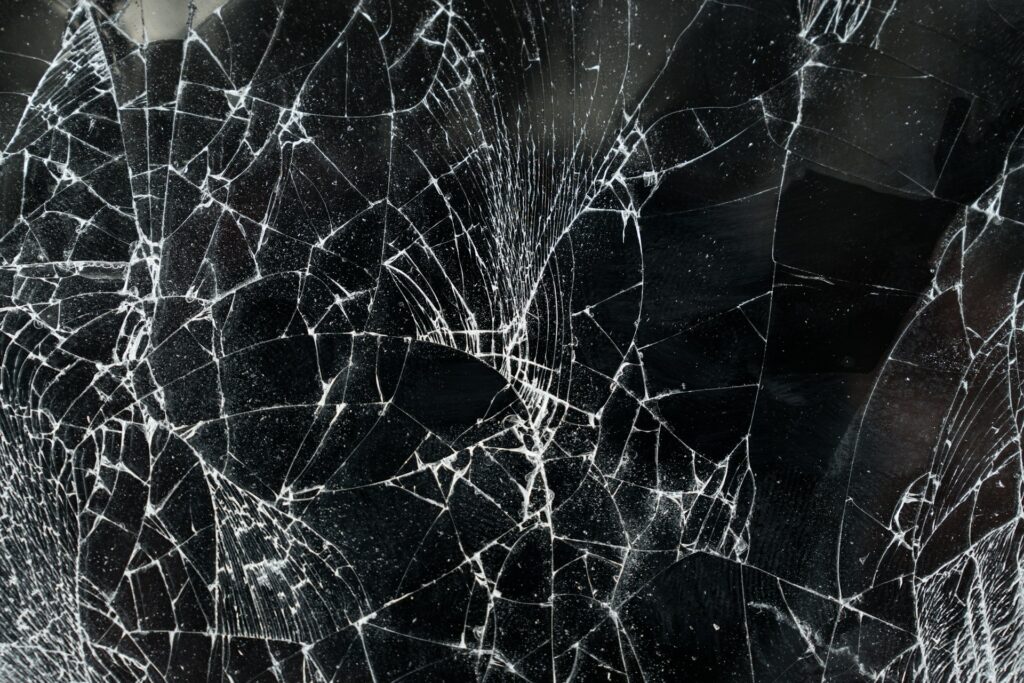
Holding the fragments together is only half the job. The film is stuck to the glass, and the glass sits in a frame. Push hard enough on a filmed pane and the whole thing can leave the opening in one piece, film and all. A burglar does not need the glass to shatter. They need the hole.
This is why 3M sells a second product alongside the film. The Impact Protection Attachment (IPA) Sealant bonds the edge of the film to the window frame itself. 3M requires it for all windstorm, break-and-entry, and explosion mitigation work, and for spontaneous glass breakage on single-pane tempered glass. For the S2400 film, 3M requires the sealant for every application.
The industry says the same thing. The IWFA says that properly specified, installed, and attached security film can slow an intruder down and give law enforcement time to respond. It also ties earthquake protection to film installed with the appropriate attachment system. The word “attached” is doing real work in that sentence.
This is also the step we see skipped most often. Sealant adds material cost and labor hours to a bid. A quote without it will always come in lower. If you are comparing two proposals and one is noticeably cheaper, ask which openings include sealant before you decide anything else.
We would rather lose a job than sell film on a promise it cannot keep. 3M is blunt in its own product documentation, and we say the same thing on site visits.
What security film does not do:
What it does do, when it is specified and installed correctly:
Read those two lists together, and you get an accurate picture. Film buys time and cuts injuries. It does not turn a storefront into a vault. We cover what that looks like on real retail glass in 3M Security Window Film for Seattle Retail Storefronts.
Thickness is the number everyone asks about first. It matters, but it is not the whole story. The 3M Ultra Series is 8 mil and micro-layered, and the layering is what gives it tear resistance—a plain 8-mil sheet would not behave the same way.
3M is also clear that the film is one variable among many. The company lists several factors that shape the outcome. Those include the film selected, the type and thickness of the glass, the building construction, the quality of the frames, and the intruder’s size, strength, and tools. A perfect film on a weak aluminum frame is still a weak opening.
On the jobs we run, two installation details separate a real security job from a cosmetic one. The first is the edge gap. Film has to run as close to the frame as the glazing allows, because a wide gap at the edge is where a filmed pane gives up first. The second is cure time. 3M advises not washing newly installed windows for 30 days so the adhesion can build. Rushing that step weakens the bond you paid for.
Most building owners inherit film they did not order. If you are trying to work out what you actually have, here is what we check on a walkthrough.
If three or more of those come back blank, the film on your building is doing less than you think. That is a common finding, and it is usually fixable without replacing every pane.
If you want to know what your glass would actually do under impact, we will come out and show you. As a 3M-authorized dealer, we assess your glass type, frame condition, and sealant needs opening by opening. We also bring a filmed sample panel, so you can see the hold for yourself before you spend anything.
Contact D&A Customs to book a free on-site assessment across Seattle, Bellevue, Tukwila, and Renton.
Will window film turn my building into a mirror? We get that question on almost every commercial quote we write in Seattle and Bellevue, and it’s a reasonable thing to ask.
The fear traces back to one famous case. In 2013, a curved glass tower in London focused sunlight onto the street below and melted parts of a parked Jaguar. The owner came back after two hours to find the wing mirror, side panels, and badge warped beyond repair. Office workers fried eggs on the pavement to prove the point.
That building had two things your building almost certainly doesn’t. Understanding what they were tells you exactly how much control you have over the way your own glass looks. Here’s the whole picture, from the physics to the product choice.
Plain glass barely reflects anything. The mirror-like look on a modern office tower comes from a thin coating on the glass surface. That coating bounces sunlight back outside instead of letting it soak into the building.
MIT architecture professor Christoph Reinhart explained this on WBUR’s Here & Now. Glass buildings scatter light because a reflective coating has been applied to the glass, and without that coating, the building would take in most of the sun’s energy instead. So the mirror effect is a side effect of a heat control decision, not a style choice made on its own.
Reinhart also made a point worth holding onto. A flat surface that acts like a mirror is not itself a problem. Trouble starts when that mirrored surface is curved inward. We’ll get to that.
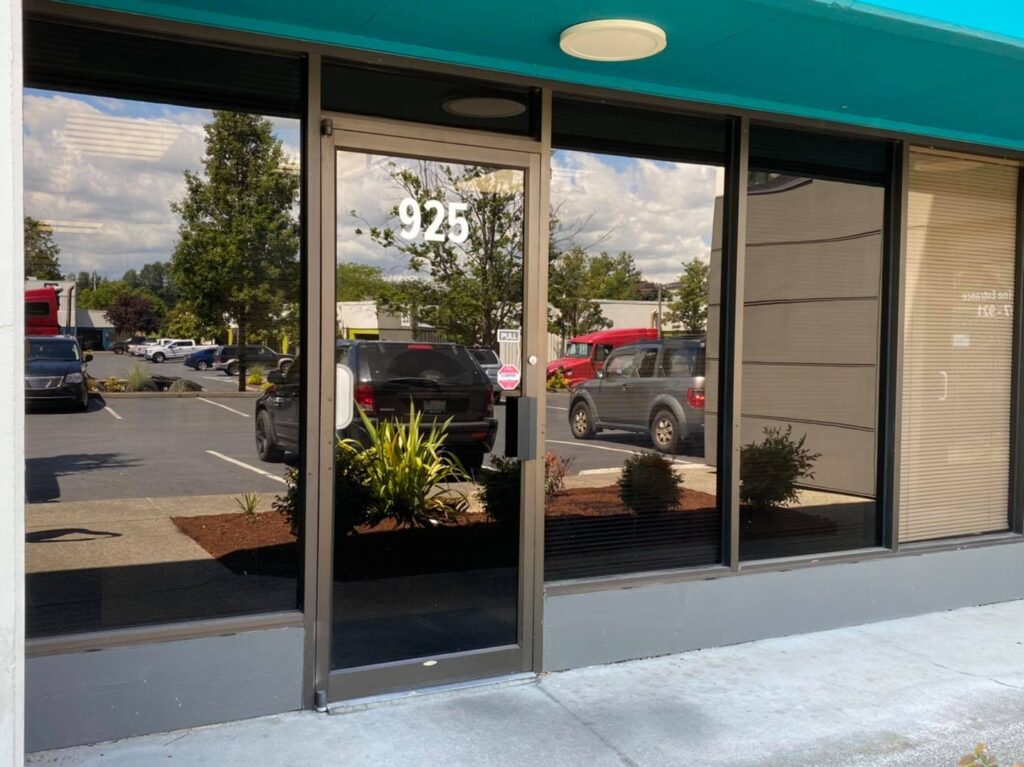
Sunlight carries a lot of heat. Once it passes through glass and hits a floor, a desk, or a wall, that heat stays in the room. Air conditioning then has to pull it back out, which costs money every hot afternoon.
Reflecting sunlight at the glass line stops the heat before it gets in. That’s the whole idea. It’s the same reason a white roof stays cooler than a black one.
Reflective glass gives an owner 3 things at once:
There’s a fourth benefit people rarely mention. A reflective facade looks uniform from the street. You don’t see a patchwork of blinds up, blinds down, and a poster taped to one window on the fourth floor.
Back to London. The Walkie-Talkie has a facade that curves inward, and that curve did something a flat wall never would. It worked like a magnifying glass.
Researchers at Imperial College London studied what happened. The concave, highly reflective face of the building captured, concentrated, and reflected sunbeams down onto the street, creating a beam of intense heat and radiation that moved as the sun moved. Carpets were scorched and office workers fried eggs on the pavement.
The team ran computer simulations to find out how bad it could have been. At its strongest, the beam put out up to 15 times more radiation than a normal London street, and twice what a person can take over thirty minutes before their skin is damaged. Professor Guillermo Rein said the beam caused no serious injury by sheer luck, and that cloud cover plus the path of the beam kept the worst case from happening.
It wasn’t the only case. Reflections from the Museum Tower in Dallas were overheating the Nasher Sculpture Center next door around the same time. The fix in London was straightforward once the problem was clear. The designer changed the original facade and added shading to stop further damage.
Two things caused this, and both had to be present. The glass was highly reflective, and the wall was curved into a bowl shape. Take away either one and there’s no beam.
Here’s where the story connects to ordinary buildings. Your office in Bellevue has flat glass. Flat glass scatters reflected light in one direction instead of focusing it on a point. There is nothing to concentrate.
The other difference is the product itself. Older solar films used metal layers, and metal is what gives you the strong mirror look. Modern commercial film mostly doesn’t work that way. 3M Prestige Series film uses a non-metalized, multi-layer optical film built with nanotechnology, and it’s designed for low reflectivity on both the inside and the outside of the glass.
The performance is still there. Prestige Series rejects up to 97% of infrared light, up to 60% of the heat coming through the window, and up to 99.9% of UV. Independent product documentation puts the exterior reflection of Prestige film at roughly 5% to 9%, which is low enough that the glass looks close to unchanged from the street.
That’s the point we make to property managers who worry about the look. You can cut heat hard and still have a building that reads as glass, not as a mirror.
Two numbers describe how film will change the look of your glass. Learn these and you can read any product sheet.
VLT stands for visible light transmitted. It’s the share of daylight that still gets through. A 70% film keeps the space bright. A 20% film makes it noticeably darker.
Visible reflectance is the share of light bounced back off the surface. This is the number that controls the mirror effect, and most people never ask about it.
3M offers architectural films across a VLT range from about 21% to 70%, and keeps visible reflectivity low, usually under 9%. For comparison, a true mirror reflects most of the light that hits it. A film at 9% is nowhere near that.
On our jobs, the glass you already have matters as much as the film. Older single-pane storefront glass, tinted glass from the 1980s, and modern double-pane units all react differently to the same product. We check what’s on the building before we quote anything, because film and glass have to be matched.
Not every building wants an invisible result. A ground-floor office facing a busy sidewalk may want the reflection. A law firm on the twelfth floor usually doesn’t. Here’s how the main film families compare.
| Film type | Look from outside | Typical VLT | Best fit |
|---|---|---|---|
| 3M Prestige Series | Close to plain glass, low reflection | 21% to 69% | Offices that want heat control without changing the facade |
| 3M Ceramic Series | Neutral, no metal, low reflection | Wide range | Buildings with lots of electronics, or where color has to stay stable for years |
| 3M Traditional Series (silver) | Clearly reflective, uniform | Lower end of the range | Storefronts and lower floors that want daytime privacy and maximum heat cut |
The silver option is not a lesser product. It does a different job. 3M’s Traditional Series silver films reject up to 79% of total solar energy, block up to 99% of UV, and the added reflection helps daytime privacy while giving the outside of the building a more uniform look. 3M cites an energy analysis by CONSOL Energy showing potential paybacks in under three years.
So the question isn’t which film is best. It’s what your building needs, floor by floor. We’ve done projects where the ground floor got a reflective film for privacy, and the upper floors got Prestige, on the same facade, on the same day.
One more thing worth knowing. 3M backs Prestige Series with a 15-year warranty on commercial buildings when the film is installed by a professional. That warranty depends on certified installation, which is part of why we went through 3M’s authorization process.
You don’t have to guess. Reflectivity is easy to judge in person and nearly impossible to judge from a product photo.
We’ll come to your building in Seattle, Bellevue, Tukwila, or anywhere in the Puget Sound area, look at your existing glass, and hold real film samples up against it. You’ll see the difference from inside and from the sidewalk before you commit to anything. We’ll also tell you if film won’t help much on your glass, because that happens too.
Book a free reflectivity consultation and sample viewing, or read more about our solar window tinting work.
Related reading:
A property manager walks past the south side of a Bellevue office building and sees it for the first time. The film on the third floor has turned a faint purple. A few windows near the corner have small bubbles along the edge.
Most people think this is just what old film looks like. That guess is close, but it misses something useful. Purple film and bubbled film are two different problems with two different causes. Each one tells you something about the film that went on your glass and the crew that put it there.
This article explains what happens inside the film and how to read what you see on your own building.
Window film is not one sheet. It is several thin layers stacked together. There is a plastic base layer, a layer that adds color or blocks heat, a layer of glue against the glass, and a hard coat on the side facing the room. Each layer wears out at its own speed.
So when someone says a film “failed,” one layer usually gave out first. Industry guidance treats this as normal wear, not a random defect. Film starts to fail when the glue, the plastic base, or the UV-blocking layer breaks down.
Two of those layers cause almost every problem you can see from the sidewalk. Here is how the signs match up:
The third one matters because people mistake it for dirty glass. Once the plastic base starts to break down, it cannot go back. On our commercial jobs in Seattle and Bellevue, hazy film is the one property managers try to clean off before they call us.
Cheap film gets its dark look from dye mixed into the plastic. That dye is usually a blend of red, blue, and yellow. Mixed together, they read as gray. Sunlight carries enough energy to break the dye apart.
The three colors do not break down at the same speed. Yellow goes first. Take yellow out of a red, blue, and yellow mix, and your eye sees purple. Industry write-ups on this point to yellow as the weakest of the three under UV light, which is why the color lands on purple so often.
Better dyed films add UV blockers that slow this down. Cheap film skips them. That is why purple can show up in the first two years. The color change is not a bad batch. It is what dyed film does in the sun.
Puget Sound gets less sun than Phoenix or Dallas, so we see this problem later here than installers in the Southwest do. It still comes. Glass facing south and west in downtown Bellevue and South Lake Union takes real sun from June through September. When someone calls us about color, those sides of the building are almost always where it started, usually on upper floors with nothing next door to block the sun.
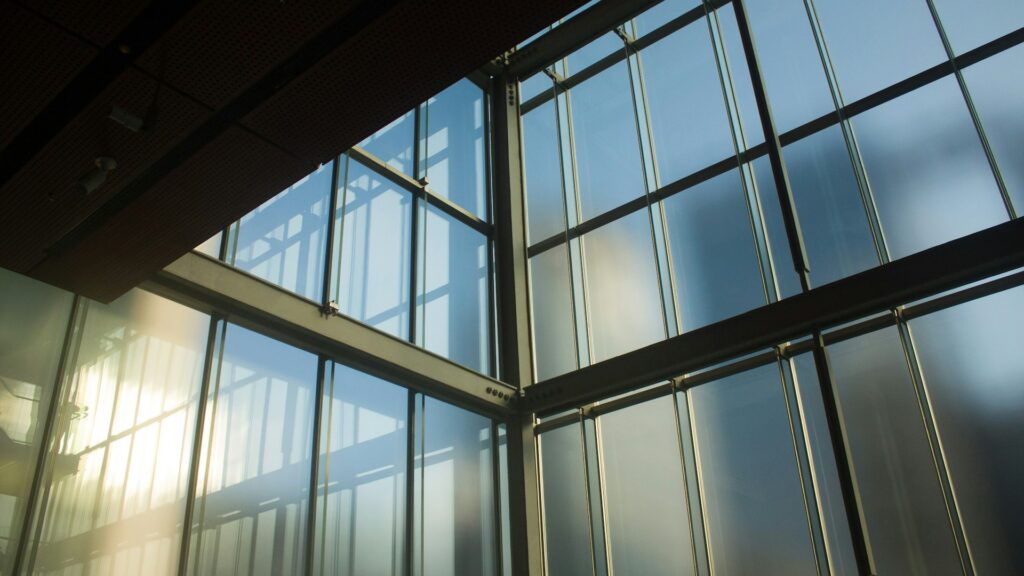
Bubbles start in the glue, not in the film you can see. Window film sticks to glass with a soft acrylic glue. That bond only holds if the film cured properly and the glass was clean on install day.
3 things break it:
Timing is what tells the three apart. Use this table to place what you are looking at:
| What you see | Likely cause | When it shows up | What it means |
|---|---|---|---|
| Small air bubbles | Dust on the glass | Right after install | Prep problem, minor |
| Water bubbles or light haze | Film still drying | First 1 to 14 days | Normal, usually clears up |
| Bubbles that spread, edges lifting | Glue breaking down | Months to years | Film has failed, needs replacing |
The read here is simple. Bubbles in week one usually settle on their own. Bubbles in year four are the glue giving up, and waiting will not fix them.
If purple comes from dye, then film made without dye has no dye to lose. That is the main difference between good commercial film and cheap film.
3M builds its Ceramic Architectural Series with tiny ceramic particles instead of dye. 3M states these films keep the same color and look over time. The line is also metal-free, so it will not rust. All Ceramic Architectural Series films come with a 12-year warranty when a pro installs them on a commercial building.
The Prestige Series gets there in a different way. It uses metal-free film built from many thin layers to block up to 97% of infrared light and up to 60% of the heat coming through the glass. It also blocks up to 99.9% of UV rays. Prestige films come with a 15-year commercial warranty when a pro installs them.
We use these lines on commercial glass because the color question stops being a question. As a 3M authorized dealer, we can answer that part in one sentence. What the film choice cannot fix on its own is the glue. Good film on dirty glass, or film rushed before it dries, still bubbles. Both halves have to be right, and that is a big part of what 3M certification asks of us.
The International Window Film Association is clear about how long film lasts. It depends on the film type, the glass type, how the window is built, which direction the glass faces, and where the building is in the world. The group also notes that all quality films come with a manufacturer warranty.
Read that list backward, and it turns into a checklist. Film that failed on one side of the building but not the others points to sun exposure. Film that failed everywhere at once points to the product itself. Film that failed at the edges first points to the install, or to water sitting where it should not.
There is a bigger version of this problem. The IWFA notes that glass breaks under stress, and that heat stress from sunlight is the kind film can affect. Film makers publish film-to-glass charts for trained installers to follow. If the first crew put dark film on the wrong type of glass without checking that chart, color is the smaller of your two worries.
We check the film-to-glass chart before we quote. Most Seattle buildings have glass from several different decades in them. On those jobs, the chart often changes which film we suggest for each side of the building.
Purple film cannot be fixed. Neither can glue that has already let go. The only real question is when to replace it, and waiting costs you in three ways.
Performance drops first. As the dye breaks down, the film blocks less heat and less UV. You keep the ugly look and lose the benefit you paid for. Removal gets harder next because old glue comes off slower and adds labor to the quote. Tenant reaction is the third, and in nicer office buildings, it is often what finally moves the budget.
Before you pay for anything, check these 4 things:
Bring those four answers to any quote and you will get a much better proposal, from us or from anyone else. The timing also ties into the payback math, which we covered for Seattle and Bellevue office buildings here.
If your building has purple, bubbled, or hazy film, we will come look at it. The inspection is free and takes about an hour on a typical commercial property. You get a written answer on what failed, why, which sides are affected, and what your glass can safely take next.
D&A Customs is a 3M authorized dealer serving Seattle, Bellevue, Tukwila, Renton, and the greater Puget Sound area. See our commercial window tinting services, or contact us to book an inspection.