Glass walls look great on a lease tour. The problem shows up on day one — your HR office faces the main hallway, your conference room has no separation from the bullpen, and every meeting is visible from the kitchen. It’s the most common reason office managers call us.
Privacy film solves it without construction, without blocking light, and without touching the lease. As an authorized 3M dealer, we install it across Seattle, Bellevue, and the broader Puget Sound area: conference rooms, lobbies, executive suites, and medical reception areas. Here’s what you actually need to know before choosing.
Why Seattle Offices Are Switching to Privacy Window Film
Blinds block light. Curtains collect dust. Neither looks right in a modern office, and both need constant maintenance. Privacy film stays on the glass, blocks the sightline, and keeps the room bright.
There’s also a local angle. Office leases in Bellevue and South Lake Union are expensive, and tenants want real upgrades without major construction. Privacy film qualifies as a reversible modification in most commercial leases—landlords approve it, it removes cleanly at the end of the term, and it adds to the space rather than limiting it. We handle lease documentation as part of the job, which helps the approval process go faster.
Types of Privacy Film for Commercial Spaces
The right film depends on how much visibility you need to block, the lighting in the space, and whether design matters. These are the four types we install most on commercial jobs.
- Frosted film is the baseline. It gives glass a sandblasted look—translucent enough to keep the room bright, opaque enough to block the view. It works in both directions, day and night, which matters for spaces with uneven interior lighting. For a basic conference room wall or HR partition, this is the most straightforward option.
- One-way mirror film lets people inside see out, while the outside sees only a reflection. It relies on light differential: the brighter side gets the reflection, the darker side gets the view. This works well on exterior-facing glass during the day, but interior office glass tends to equalize lighting after hours, which kills the effect. We’ll tell you upfront when it makes sense and when it won’t hold up.
- Gradient film fades from opaque at one end to clear at the other. The most common application is a conference room partition — frosted at seated height, clear above. You get the privacy where you actually need it without closing off the space. 3M’s Fasara Gradation series handles this particularly well, with a range of fade patterns from subtle to sharp.
- 3M Fasara decorative film is the premium option when design matters as much as function. Over 100 patterns (fabric textures, geometric designs, rice paper, dot grids, gradation styles, etc.) that look like custom etched or sandblasted glass. 3M’s documentation describes Fasara as delivering the look of etched, cut, or textured glass at a fraction of the cost. More on this below.
We can help you with choosing the right option for your office.
Conference Room Privacy Film — The Most Common Application
Conference rooms are where we do most of our privacy film work. Glass-walled meeting rooms are standard in Seattle offices, and they’re also where the problem is hardest to ignore—client calls, performance reviews, board discussions, all fully visible from the hallway.
The install we do most often: frosted film on the lower two-thirds of the glass, clear above. This covers seated sightlines entirely while keeping the upper half open. It’s clean, it’s professional, and it works in rooms of any size. For clients who want something more designed, we use 3M Fasara gradient patterns on the same area.
A 10-person conference room takes three to five hours from surface prep to cleanup. Most clients book an early morning slot, and the room is usable the same day. We work around your schedule, not the other way around.
One thing worth noting on compliance: the IBC requires distraction markers at 30 and 60 inches from the floor on full-height glass walls. Privacy film applied at those heights can satisfy both requirements at once, safety code and privacy, single install. We check this as part of the initial site visit.
How Privacy Film Works as Office Branding
Your company logo, cut from frosted vinyl and applied across a reception window or glass partition—that’s both a safety marker and a brand element. Same install, same cost, two functions.
We use digital plotter-cutting to translate a logo file into a precise frosted cut. A Bellevue tech company might run a repeating geometric pattern tied to its brand language. A medical office might use simple horizontal bands in a specific opacity. The film reads as intentional design, not a sticker, not a workaround.
For companies with multiple offices, this also solves a consistency problem. 3M guarantees uniform manufacturing across its Fasara line, which means the conference room finish in your Seattle HQ will match the one in your Bellevue office exactly. Custom etching can’t do that because it varies by vendor and by hand.
3M Fasara: The Premium Option for Seattle Offices
We recommend Fasara when the design of the space carries real weight: hospitality, executive floors, client-facing offices, or any space where “basic frosted” undersells the interior.
Fasara is a polyester decorative film that gives glass the look of etched or sandblasted surfaces, typically at less than a third of the cost of custom glass replacement. The pattern library covers four main categories: fabric and matte finishes, gradation and combination patterns, prism and dot designs, and stripe or border styles. The Gradation series is the most requested for conference rooms. Fabric and matte finishes suit offices with a more refined aesthetic.
On the specs: Fasara blocks 99% of UV light, carries a Class A fire rating under ASTM E84, and lasts up to 10 years under normal commercial use. It’s polyester rather than vinyl, which means it installs cleaner and removes without residue, which is important for leased spaces.
As an authorized 3M dealer, our Fasara installs come with the full manufacturer’s warranty covering both film and labor. Generic decorative films don’t carry this, and the quality gap shows within a few years.
What the Installation Process Looks Like
- We start with an on-site visit: measure the glass, check the surface condition, assess the glazing type. This isn’t optional. Certain reflective films create thermal stress on older insulated glass units, and we won’t recommend a product that could void your building’s glass warranty. If your lease has restrictions on modifications, we review those too and provide documentation for landlord approval if needed.
- Installation day: we prep the surface, apply the film, trim edges, and do a final squeegee pass. Single-room jobs are typically finished by mid-morning. Multi-floor projects run room by room over one or two days. The space is usable immediately after install; full cure takes a few days.
- We don’t leave until the work is signed off. If an edge needs a final trim or a pattern alignment is off, we fix it on-site. After that, we hand over documentation — 3M product code, warranty terms, install date, which building managers typically keep on file for maintenance records.
If you want to see what privacy film looks like on your specific glass before committing, we offer free on-site assessments. We bring samples, take measurements, and give you a written quote.
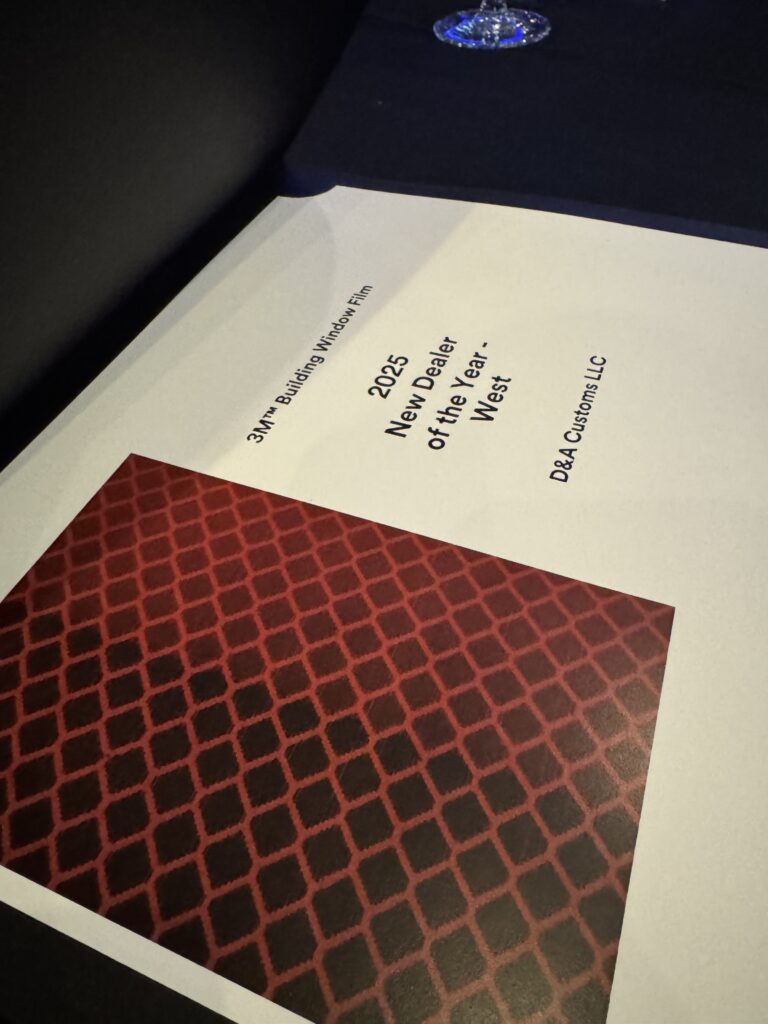
Earlier this year, 3M named D&A Customs the Best New Dealer on the West Coast. It’s a recognition we’re proud of, but this article isn’t about the award. It’s about what the certification actually means when you’re choosing a commercial window film installer for your building in Seattle, Bellevue, or Tacoma.
Property managers ask us this question regularly: “Why does it matter who installs the film, as long as the film is 3M?” It’s a fair question, and here’s the honest answer.
What Does “3M Authorized Dealer” Actually Mean?
Not every installer who mentions 3M in their marketing is an authorized dealer. 3M makes several entry-level films available to the general public, which means any company can legally advertise “3M window tinting” without holding a dealer agreement.
Authorized dealer status is different. It requires a formal dealer agreement with 3M, verified training, validated business practices, and confirmed liability and insurance coverage. According to 3M’s own certification structure, dealers can hold one of four levels: Premier, Premier Elite, 3M Certified, and 3M Large Commercial Certified — each requiring more demonstrated knowledge and project experience than the one before.
Only authorized dealers can purchase and install 3M’s high-end specialty films, including the 3M Prestige Series and 3M Safety Series. These products are not available through retail or general supply channels. When you hire a non-authorized installer who claims to use these films, you have no way to verify the product is genuine, and no 3M warranty protection.
Why 3M Certification Matters for Commercial Window Film Projects
- The warranty is the most concrete reason. When an authorized dealer installs 3M Prestige Series film on your commercial building, the warranty comes directly from 3M, not from the installer alone. 3M Prestige Series interior films carry a 15-year commercial warranty covering defects, delamination, and significant performance issues. 3M Safety Series films carry a 10-year commercial warranty. A non-authorized installer cannot offer these warranties, regardless of what they put in writing.
- The second reason is glass compatibility. Commercial buildings in Seattle vary significantly — older curtain wall systems in First Hill, newer double-pane units in the Eastside office parks, and single-pane retail storefronts in Capitol Hill. The wrong film on the wrong glass can cause thermal stress fractures, especially on sealed insulated units. Authorized dealers are trained to assess glass type before recommending any product. We do this on every job, without exception.
- Third: project scale. 3M’s Large Commercial Certified level exists specifically for multi-building or high-square-footage projects. If you’re managing a property with several floors of glazing or multiple buildings across a campus, certification level matters for both competence and liability.
The 3M Commercial Window Film Product Range We Install
As an authorized 3M dealer, we install the full range of 3M architectural window films. Each product in the lineup is designed for a specific commercial problem, and understanding the differences helps you ask better questions before committing to any project.
Here’s a brief overview of what we work with most often on Seattle-area commercial projects:
| Product |
Primary Use |
Commercial Warranty |
| 3M Prestige Series |
Solar control, glare, UV |
15 years |
| 3M Night Vision Series |
Clarity + solar control |
15 years |
| 3M Safety & Security Series |
Glass retention, smash resistance |
10 years |
| 3M Fasara Series |
Decorative, privacy |
Varies by product |
| 3M DI-NOC |
Surface film, interior finishes |
Varies by product |
Each of these requires different installation techniques and glass compatibility checks. One of the most common mistakes we see is a building manager asking for “privacy film” and getting a product that wasn’t designed for their glazing type. The authorization and training process exists to prevent that outcome.
3M Prestige Series: Solar Control for Seattle Office Buildings
The Prestige Series is the product we install most often on office buildings across Seattle, Bellevue, and Redmond. It’s 3M’s flagship solar control film, and the technology behind it is worth understanding before you decide on any sun control solution.
Traditional solar control films work by reflecting or absorbing heat using metallic layers. The Prestige Series uses a different approach: non-metalized, multi-layer optical film with nano-technology. The result is a film that rejects up to 97% of the sun’s infrared light and up to 60% of the total heat coming through your windows — without changing the appearance of your building’s glass. Interior and exterior reflectivity stay low, so you don’t get the mirror effect that older films create.
For Seattle offices, this matters for two reasons. First, the Pacific Northwest gets intense summer glare even though temperatures are moderate. The long afternoon sun angles from June through September create uncomfortable hot spots near west-facing windows, which pushes up air conditioning loads and pulls employees away from window seats. Second, the non-metallized construction means the film doesn’t interfere with Wi-Fi, cellular signals, or GPS — relevant for any building with high network density. We’ve installed Prestige on several multi-tenant office buildings in South Lake Union and Bellevue’s Spring District where signal interference from metallized film would have been a real problem.
The 15-year commercial warranty on Prestige is also worth noting in context. Most of the non-3M films we see in older buildings were installed with 5–7 year warranties from companies that no longer exist. 3M has been in the film business since they held the first window film patent in 1966. The warranty has institutional backing behind it.

3M Safety & Security Film: Protection for Commercial Glass
The Safety Series addresses a different problem: what happens to your glass when it breaks. Standard glass shatters into sharp fragments on impact. 3M Safety film is designed to hold broken glass together when a window or door is struck, whether the cause is a smash-and-grab attempt, a seismic event, or accidental impact.
When installed with the 3M Impact Protection Attachment (IPA) Sealant, the film anchors the glass to the frame. This combination is what makes the system effective for security applications. Film alone slows penetration. Film plus IPA sealant creates significantly more resistance. The distinction matters, and any installer recommending safety film for security purposes should be specifying both.
We install Safety Series in Seattle-area retail storefronts, lobbies, and ground-floor office entrances. It’s also increasingly common in healthcare facilities and school buildings where glass management during an incident is part of the safety plan. The film is optically clear, it doesn’t change the look of the glass at all. From the outside, there’s no visible difference. That’s the point. The protection is there when it’s needed, invisible until it is.
A note on what safety film does not do: it is not bulletproof and is not designed to stop a determined intruder indefinitely. It slows penetration and buys time. We’re always direct about this with clients specifying film for high-risk environments — the product description from 3M is clear on these limitations, and we pass that information along before any project starts.
3M Fasara & Decorative Films: Privacy and Branding Solutions
3M Fasara is a different category from the solar and security films. It’s a decorative and privacy film designed for interior glass surfaces — conference rooms, reception areas, office partitions, and storefront glass where you want visual separation without blocking light.
Fasara comes in over 100 pattern options, ranging from simple frosted to geometric, organic, and abstract designs. Unlike basic frosted vinyl, it’s a precision-manufactured film with consistent optical quality and a finish that withstands commercial cleaning routines without degrading. As an authorized dealer, we have access to the full Fasara catalog, not a limited selection from a distributor’s stock.
We pair Fasara with corporate branding applications more often than people expect. A company with branded cut vinyl on a glass wall and frosted film on adjacent panels is using the same glazing surface to handle two functions at once — branding and privacy. It reduces the need for additional partitions and works within existing leased office spaces without structural changes. If you’re an office tenant in a Bellevue or Seattle lease, Fasara is also easier to get landlord approval for than most permanent modifications, since it’s removable on lease termination.
What Our 3M Certification Means for Your Warranty
Here’s the practical summary of what authorized dealer status means when you sign a contract with us.
- The warranty on your 3M film comes from 3M directly, backed by a company that has been in business for over 120 years. The warranty covers defects, delamination, blistering, and significant performance degradation. It does not come solely from us; if we closed tomorrow, your 3M warranty would still be valid.
- We provide a 3M ID number on every project, which you or your property management team can use to verify our authorization directly with 3M. We also provide a commercial reference list of completed projects on request — a requirement of our dealer agreement. If you’re comparing installers, ask every one of them for this. An authorized dealer can provide it. An unauthorized installer cannot.
- Our glass compatibility assessment is included on every commercial quote. We won’t recommend a product we can’t confirm will work on your specific glazing. If the glass type creates a thermal stress risk with a particular film, we tell you before we start — not after.
If you’re managing a commercial property in Seattle, Bellevue, Tacoma, or anywhere in the Puget Sound region and want a quote or a site assessment, contact us. We’ll walk through your building’s glazing, the products that fit your goals, and the warranty terms before you commit to anything.
If you’re looking into wall graphics for your business, you already know one thing: the market looks the same on the surface, but results vary wildly.
Some companies install wall graphics and watch foot traffic increase, brand recall jump, and customers post their space on Instagram. Others end up with what looks like overpriced wallpaper.
The difference isn’t the material. It’s the approach.
Not all wall graphics work the same way:
- Some are real marketing tools that drive sales
- Others are just stickers on a wall
In this guide, we’ll cover:
- What wall graphics actually are and how they drive business results
- A side-by-side comparison of the top 5 providers in 2026
- How to choose the right solution for your space (office, retail, restaurant, fitness)
- The biggest mistakes that waste your budget
Ready to upgrade your space with wall graphics that actually work? Check out D&A Customs Wall Graphics services – custom design and certified 3M installation across Seattle, Bellevue, and the greater Puget Sound area.
Table of Contents
- What are wall graphics and why businesses use them
- Top 5 wall graphics providers compared
- Why custom solutions outperform templates
- Top 5 wall graphics solutions for business in 2026
- D&A Customs – best for branded business spaces
- SquareSigns – large catalog, template-driven
- Blik – designer decor for residential use
- Decals.com – fast and simple, low customization
- WallMonkeys / Fathead – mass-market decals
- What types of wall graphics actually drive results in 2026
- How to choose wall graphics that work (and avoid budget mistakes)
- Frequently asked questions
What are wall graphics and why businesses use them
Wall graphics are large-format printed vinyl, films, or decals applied to interior or exterior walls. They’re used for branding, decoration, advertising, wayfinding, and atmosphere creation.
But here’s the key insight: for businesses, wall graphics aren’t decoration. They’re a sales tool.
Why? Because the right wall graphics:
- Increase brand recognition and recall
- Shape the first impression a customer forms in the first 3-5 seconds of entering your space
- Drive social sharing (the Instagram effect – customers become marketers)
- Differentiate you from competitors with templated, generic spaces
- Create wayfinding and functional design in offices, clinics, and large retail
And the most underrated benefit: they’re dramatically cheaper than a full renovation, but produce a comparable transformation in how a space feels and performs.
That’s why search demand keeps growing for terms like:
- custom wall graphics for office
- commercial wall graphics
- retail wall graphics
- vinyl wall murals for business
- wall graphics installation near me
Quick numbers: well-designed branded environments can lift in-store dwell time by 20-30% and improve brand recall by up to 70% (compared to generic, unbranded spaces). The investment in wall graphics typically pays back through increased customer engagement and word-of-mouth marketing within months, not years.
Top 5 wall graphics providers compared
A quick side-by-side before the detailed breakdown:
| Provider |
Best for |
Customization |
Branding focus |
Installation |
Result type |
| D&A Customs |
Branded business spaces |
Maximum |
Strong |
Certified, in-house |
Drives sales |
| SquareSigns |
DIY users, small projects |
Limited |
Weak |
DIY only |
Decoration |
| Blik |
Residential design |
Medium |
Minimal |
DIY only |
Decoration |
| Decals.com |
Quick standard decals |
Low |
Weak |
DIY only |
Decoration |
| WallMonkeys / Fathead |
Mass-market, themed |
Low |
None |
DIY only |
Decoration |
* Pricing varies widely by size, material, and installation requirements.
Why custom solutions outperform templates
If you’re spending more time choosing from a template library than thinking about what your space should communicate, you’re already on the wrong track.
- Brand fit matters more than visual appeal. A beautiful generic mural that doesn’t reflect your brand is just expensive wallpaper.
- Your competitors use the same templates. Stock decal catalogs are public – anyone can buy the same thing. That defeats the entire point.
- Installation quality is the difference between professional and amateur. Bubbles, peeling edges, misaligned graphics – all signs of DIY or poorly trained installers. Customers notice.
- Material grade affects longevity. Cheap vinyl fades, lifts at corners, or damages walls when removed. Premium 3M materials hold up for years.
Industry insight: commercial spaces with custom branded environments report significantly higher employee engagement and customer return rates than those using generic decor – because the space itself becomes part of the brand experience.
Top 5 wall graphics solutions for business in 2026: detailed breakdown
Each option below is broken down by the same criteria so you can compare apples to apples – not marketing claims to marketing claims.
1. D&A Customs – best for branded business spaces
D&A Customs is a Seattle-based commercial graphics specialist serving the greater Puget Sound region (Seattle, Bellevue, Tukwila, Renton, Kirkland, Redmond, Burien). Two physical locations, certified 3M installer, full in-house design team.
Unlike template-driven services that ship vinyl from a catalog, D&A Customs treats wall graphics as commercial design + brand strategy + premium installation. Every project is custom-built around the client’s brand, space, and business goal – whether that’s brand reinforcement in a lobby, an Instagram-worthy moment in a restaurant, or wayfinding in a medical facility.
Why businesses choose D&A Customs:
- Custom design from scratch – in-house design team creates a proof for approval before anything is printed
- Premium 3M and Avery Dennison materials – certified installer, real warranty
- Climate-controlled installation – shops monitored 24/7 for temperature, humidity, and dust (these affect long-term adhesion)
- End-to-end service – consultation, design, production, installation, removal
- Commercial expertise – clients include Sound Transit, medical facilities, retail chains, and local businesses
- Local Pacific Northwest knowledge – knows which materials hold up in Seattle’s climate
- Range of services beyond wall graphics – window graphics, commercial window tinting, 3M DI-NOC surface refinishing, and vehicle wraps
Best for:
- Office spaces, lobbies, and reception areas wanting branded environments
- Retail and restaurant interiors looking to drive customer engagement
- Medical facilities, clinics, and government spaces requiring professional wayfinding
- Coworking spaces, gyms, and salons that want Instagram-shareable moments
- Property managers and architects spec-ing out commercial buildouts
- Local Seattle and Puget Sound businesses needing a reliable installer
Pros of D&A Customs:
- True custom design – no templates
- 3M Certified Installation with real warranty
- Bonded, insured, and licensed
- Free consultation and honest quotes (no vague estimates)
- Two locations across Puget Sound for accessibility
- Fast turnaround with realistic timelines that get hit
- Strong portfolio of verified Google reviews from real commercial clients
Cons:
- Local to the Seattle / Puget Sound region – not a national e-commerce shop
- Higher upfront investment than DIY decal kits (but much higher long-term value)
Pricing:
Custom quote based on size, material, design complexity, and installation. Free consultation included. Typical commercial wall graphics projects range from $8 to $25 per square foot installed, depending on substrate and material grade.
Ready to start? Request a free consultation – D&A Customs responds to every inquiry within 24 hours. Or browse the project gallery to see real installations across Seattle.
2. SquareSigns – large catalog, template-driven
SquareSigns is an online sign and graphics retailer with a wide product catalog and a self-serve online configurator. Suitable for small businesses and DIY projects where speed and price matter more than brand differentiation.
Features:
- Online product configurator
- Wide selection of standard formats
- Quick checkout and shipping
Best for:
- Small businesses needing simple, off-the-shelf signage
- DIY users with their own basic design files
- Projects where speed and cost outweigh brand uniqueness
Pros:
- Easy ordering process
- Predictable pricing on standard products
- Wide product range
Cons:
- Template-driven, limited true customization
- No installation service – you handle it
- Weak focus on brand strategy or commercial design
- Generic results that don’t differentiate your space
Bottom line: better suited for DIY projects than for businesses that need brand-driven results.
3. Blik – designer decor for residential use
Blik focuses on stylish, designer-oriented wall decals primarily for residential and lifestyle use. Curated artist collaborations and a strong design aesthetic – but limited fit for commercial branding.
Features:
- Designer collections and artist collaborations
- Aesthetic-driven product line
- Quality removable vinyl
Best for:
- Homeowners decorating residential interiors
- Kids’ rooms, nurseries, lifestyle spaces
- Boutique cafés or shops with a residential aesthetic
Pros:
- Strong design quality on standard products
- Quality materials
- Curated, taste-driven selection
Cons:
- Not built for commercial brand applications
- Limited custom branding capability
- No installation service
- Smaller scale – not designed for large commercial walls
Bottom line: excellent for home use, limited for serious business branding.
4. Decals.com – fast and simple, low customization
Decals.com is a high-volume vinyl decal e-commerce shop. Wide variety, easy ordering, but mostly templated designs with minimal customization beyond text and color swaps.
Features:
- Large catalog of pre-made designs
- Fast order processing
- Bulk ordering options
Best for:
- Quick decal needs (windows, vehicles, basic signage)
- Small businesses with simple text-based decal needs
- Customers who don’t need design help
Pros:
- Affordable for simple projects
- Easy to order online
- Fast shipping
Cons:
- Standard, templated designs
- Minimal custom design support
- No installation included
- Low brand differentiation potential
Bottom line: a transactional vendor for basic decals – not a partner for branded environment design.
5. WallMonkeys / Fathead – mass-market decals
WallMonkeys and Fathead operate in the mass-market themed decal space – sports figures, characters, stock photography prints. Useful for kids’ rooms or fan spaces, less so for branded business environments.
Features:
- Massive catalog of themed and licensed decals
- Sports, entertainment, and character licensing
- Quick fulfillment
Best for:
- Kids’ rooms, themed bedrooms
- Sports bars or themed venues
- Quick decorative installs without strategic intent
Pros:
- Huge catalog
- Themed and licensed options
- Affordable mass-market pricing
Cons:
- Zero brand uniqueness
- Not designed for commercial brand environments
- No design or installation service
- Low-grade vinyl in many SKUs
Bottom line: decoration product, not a business solution. Skip if you’re trying to build brand equity.
What types of wall graphics actually drive results in 2026
Across hundreds of commercial installations, four formats consistently deliver the strongest ROI:
1. Branded brand walls (logo + story)
Where they work: office lobbies, reception areas, showrooms, conference rooms.
Why: creates trust and brand recognition in the first 3-5 seconds. Visitors form an opinion of your company before anyone speaks.
2. Full-wall murals
Where they work: retail, restaurants, gyms, large open commercial spaces.
Why: transforms atmosphere, creates a focal point, drives photo sharing. A single well-designed mural can change how a space feels.
3. Wayfinding and functional graphics
Where they work: offices, coworking spaces, medical clinics, schools, government facilities.
Why: not just attractive – actually useful. Reduces friction, helps visitors orient, and supports a polished operational image.
4. Instagram zones
Where they work: cafés, restaurants, salons, retail stores, fitness studios.
Why: when customers post your space online, they become unpaid marketers. The right photo-worthy wall can drive substantial organic reach.
How to choose wall graphics that work (and avoid budget mistakes)
Five common mistakes that turn wall graphics from a marketing investment into a sunk cost:
Mistake 1: Choosing “looks nice” over “drives result”
Beautiful doesn’t always work. A great-looking generic mural that doesn’t reflect your brand or invite customer engagement is decoration, not marketing. Define the business goal first.
Mistake 2: Going with templates
If your wall graphic could appear in any other business, it’s not branding. Template = same as everyone else = zero competitive advantage.
Mistake 3: Skipping the strategy step
Wall graphics should be part of your marketing strategy, not an afterthought. What story should the space tell? What action should visitors take? Where will customers naturally photograph it?
Mistake 4: Cutting corners on materials
Cheap vinyl fades, lifts at the edges, and damages walls during removal. Premium 3M-grade vinyl lasts 5-10+ years and removes cleanly. The math almost always favors quality.
Mistake 5: DIY installation on commercial-scale work
Bubbles, misalignment, and peeling edges signal a low-quality operation to your customers – even if your brand isn’t. Professional installation is the difference between “looks like a business” and “looks like a side project.”
What you actually need for results:
- Custom design tied to your brand strategy
- Strategic placement based on customer flow and sightlines
- Professional installation with premium materials
- A clear vision for how the graphic supports your business goal
That’s the difference between “a sticker on the wall” and “an asset that drives sales.”
Conclusion: which wall graphics solution should you choose in 2026?
If you just need a basic decal for a kid’s room or a temporary sign, the mass-market services work fine. They’re cheap, fast, and predictable – within their limits.
If your goal is building a branded environment that drives business results, the choice narrows quickly. You need custom design, premium materials, and certified installation – all working together as one process.
That’s exactly why Seattle-area businesses, architects, and property managers choose D&A Customs. Not because they’re the cheapest option – but because they treat wall graphics as a commercial design discipline, not a vinyl shipping business.
Next step: request a free consultation to discuss your space, your brand, and your goal. Or call 425-633-6288 to talk through your project. Free consultations, honest quotes, 24-hour response time. You can also explore the project gallery to see real wall graphics installed across Seattle, Bellevue, and the greater Puget Sound area.
Frequently asked questions about wall graphics
What are wall graphics and how do they work for business?
Wall graphics are large-format printed vinyl applied to interior or exterior walls used for branding, wayfinding, decoration, or advertising. For businesses, they function as a marketing tool that builds brand recognition, shapes customer perception, and creates memorable spaces – at a fraction of the cost of a full renovation.
How much do custom wall graphics cost?
Pricing depends on size, material, design complexity, and installation. Template-based decals start around $30-$200 per piece. Custom commercial wall graphics with design and professional installation typically range from $8 to $25 per square foot, depending on the substrate and material.
Are wall graphics permanent or removable?
Both options exist. Removable vinyl is ideal for temporary campaigns, seasonal promotions, or rented spaces and lasts 1-3 years. Permanent wall graphics use durable cast vinyl that lasts 5-10+ years and is suitable for long-term branding.
Will wall graphics damage my walls when removed?
When professionally installed and removed using the correct materials (such as 3M removable adhesives), wall graphics come off cleanly without damaging paint or drywall. Cheap, off-the-shelf decals can leave residue or pull paint when removed.
How long does it take to design and install wall graphics?
Custom projects typically take 1-3 weeks from concept to installation. Design and approval take 3-7 business days, production takes 3-5 days, and installation depends on size – usually a few hours to a full day for large murals.
Can wall graphics be applied to textured walls?
Yes, but it requires the right material. Specialized textured-surface vinyl (like 3M IJ8624) is designed to conform to brick, stucco, concrete, and rough textures. Standard vinyl will fail on these surfaces – this is one reason to work with a certified installer who knows the right material for the job.
What’s the difference between wall graphics and wallpaper?
Wall graphics are typically vinyl-based, removable, and used for shorter-term branding or design. Traditional wallpaper is paper-based, more permanent, and harder to remove or change. Vinyl wall graphics give you brand flexibility – you can refresh them as your brand evolves.
Do you offer wall graphics installation in Seattle and Bellevue?
Yes. D&A Customs has two locations serving the greater Puget Sound region: Tukwila and Bellevue. We install wall graphics across Seattle, Bellevue, Tukwila, Renton, Kirkland, Redmond, Burien, and surrounding areas.
Can wall graphics work for outdoor use?
Yes, with the right material. Outdoor-rated vinyl with UV protection lasts 5-7 years in exterior conditions. The Pacific Northwest’s wet climate especially demands proper material selection – using interior vinyl outside leads to fast failure.
Do you handle the design or do I need to provide artwork?
D&A Customs has an in-house design team that creates artwork from scratch based on your brand. You don’t need to provide print-ready files. We design, you approve, we produce and install.
Sunlight makes a space feel open and bright, but over time it can do real damage. You may notice your floors start to fade, your couch loses its color, or wood finishes look worn much sooner than expected. It often happens slowly, so most people don’t catch it right away. Data from the Skin Cancer Foundation shows that up to 40% of fading comes from UV rays, with the rest caused by visible light and heat. That means even normal daylight through your windows can take a toll. The good part is you don’t have to live with it or block your windows to fix it.
Why Sunlight Damages Furniture, Flooring, and Interiors
Sunlight does more than brighten a room. Over time, it slowly wears down the things inside it. You might not notice it right away, but the damage builds up day by day. Different parts of sunlight affect your space in different ways:
- UV rays – fade colors and break down materials
- Visible light – causes gradual color loss
- Heat – dries out wood, fabric, and finishes
According to the U.S. Department of Energy, standard window glass can allow up to 75% of the sun’s heat into a space. That is why areas near windows fade faster than the rest of the room. You may see uneven spots on your floors or furniture that no longer match. Once that happens, there is no simple fix.

The Real Cost of Sun Damage in Homes and Commercial Spaces
Sun damage is easy to ignore at first. A little fading here, a slight color change there. But over time, it adds up and starts to cost real money. Most people only notice it when something no longer looks right.
Here is where the impact shows up:
- Furniture – colors fade and materials wear out faster
- Floors – you get uneven patches that are hard to fix
- Retail displays – products lose color and look older
- Office spaces – worn interiors can leave a bad impression
The International Window Film Association points out that sun exposure is a major reason interiors age faster than expected. That means more repairs, more replacements, and more money spent over time.
In many spaces, the damage near windows stands out the most. You might move a rug or a chair and suddenly see how much the color has changed. At that point, fixing it is not simple or cheap.
Why Curtains and Blinds Are Not Enough
Curtains and blinds can help with glare and privacy, but they are not designed to fully protect your interior from sun damage. The main issue is consistency. They only work when they are closed, and most people keep them open during the day.
Here is how they compare to window film:
| Feature |
Curtains & Blinds |
Window Film (3M Prestige) |
| UV protection |
Low to moderate (depends on fabric) |
Up to 99% UV blocked |
| Coverage |
Partial, with gaps |
Full window coverage |
| Consistency |
Only when closed |
Works all day |
| Natural light |
Reduced when closed |
Maintained |
| Appearance |
Blocks view |
Clear, no visual change |
Window coverings can reduce heat gain, but their performance depends on how they are used. That means protection is not constant. In real life, blinds are often open during peak sunlight hours. That is when UV rays, heat, and visible light hit your floors and furniture the most. Window film works in the background all day, so you get protection without having to think about it.
How 3M Prestige Window Film Protects Your Interior
If you want to keep your space bright but stop the damage, window film is a smart fix. 3M Prestige Series is built to filter out the parts of sunlight that cause fading, without making your windows look dark or reflective.
Here is what it does in real terms:
- Blocks up to 99% of UV rays – the main cause of fading
- Reduces heat by up to 97% (infrared rejection) – helps protect wood, fabrics, and finishes from drying out
- Lets in natural light – your space stays bright, no heavy tint
- Works all day – no need to adjust anything like blinds or curtains
What makes this film different is how it’s made. Instead of using metal layers, 3M uses a multi-layer optical film. That allows it to block heat and UV without creating glare or interfering with signals like Wi-Fi or mobile service.
Here is why that matters in everyday use:
- No dark rooms – you keep the same look and feel
- No mirror effect – windows stay clear from both sides
- No signal issues – unlike some older films
3M data also shows that high-performance window films can reject a large portion of solar energy before it enters the room. That reduces temperature swings near windows, which is one of the main reasons materials fade unevenly.
In simple terms, you still get the sunlight, just without the part that causes damage. Over time, that makes a big difference in how your floors, furniture, and finishes hold up.
What Makes 3M Prestige Different from Standard Window Film
A lot of window films look similar at first, but the difference shows up after installation. Some films make your windows darker, some create a mirror effect, and others can even affect your phone signal. That usually comes down to how the film is made.
Here is how 3M Prestige is different in real use:
- No metal inside the film – your Wi-Fi, calls, and GPS keep working like normal
- Clear look from the inside and outside – no “tinted office” feel
- Consistent performance across the glass – no uneven spots or color shifts
- Holds up over time – less risk of turning purple or fading like older films
3M builds this film with hundreds of ultra-thin layers instead of dyes or metal. That lets it manage heat and light in a more precise way. You still get a bright room, but with less heat and less exposure to the rays that cause fading.
Here is what people usually notice after installation:
- Rooms feel cooler near windows
- Glare is reduced without making the space dark
- Furniture and floors keep their color longer
With standard films, you often have to accept trade-offs. Either the room gets darker, or the film does not last. With Prestige, the goal is simple: protect your space without changing how it looks or feels.

Where Window Film Makes the Biggest Difference
In most spaces, fading doesn’t happen everywhere at once. It shows up in very specific spots, usually where sunlight hits the same surface every day.
You’ll see the biggest difference in places like:
- Right in front of large windows – this is where floors often fade in long полоси or patches
- Under glass doors or sliding doors – constant exposure leads to a clear color contrast over time
- Next to windows in living rooms – one side of a sofa fades faster than the other
- Storefront glass – items in displays lose color even if they are not in direct sun all day
This is why people often notice the issue only after moving something. A rug gets pulled back, and the floor underneath looks like a different shade. A chair gets rearranged, and one side looks newer than the other.
Window film works best in these exact areas because it creates a consistent barrier across the glass. Instead of certain spots taking all the damage, the exposure gets controlled before it reaches your floors and furniture.
Installation Process: What to Expect with D&A Customs
When you work with D&A Customs, the process is simple and handled by a team that does this every day. You’re not guessing what film to pick or how it will look. They walk you through it and take care of the details.
Here is how it usually goes:
- On-site visit – a D&A Customs specialist checks your windows, looks at sun exposure, and points out where fading is most likely
- Film recommendation – you get a clear suggestion based on your space, not a generic option
- Glass preparation – windows are cleaned the right way so the film sits flat with no dust or bubbles
- Professional install – the film is cut and applied on-site for a precise fit
- Final walkthrough – you see the result and get care tips before the team leaves
In a typical home, this can take just a few hours. For offices or retail spaces, it may take longer, but the work stays clean and organized. No heavy tools, no major disruption.
Here are a few details customers often notice:
- Furniture stays in place in most cases
- No strong odors or mess left behind
- Windows look the same right after install, just clearer and more comfortable
From your side, it feels like a quick upgrade. The bigger change comes after, when the space stays cooler and your floors and furniture stop taking daily damage.
Protect Your Interior Before Damage Becomes Permanent
Most people don’t think about sun damage until they move a rug or rearrange a room. That’s when it becomes obvious. One part of the floor looks new, the rest doesn’t. At that point, the change is already set.
Here are small signs that show up early:
- A lighter strip along the window side of the floor
- One arm of the sofa looks more worn than the other
- Wood surfaces lose depth and start to look flat
- Rooms feel much hotter near the glass during the day
These are not random changes. They come from the same sunlight hitting the same spots every day. Over time, the difference becomes harder to ignore.
Fixing it usually means:
- Refinishing floors
- Replacing furniture or upholstery
- Reworking displays or interiors
Those are bigger, more expensive steps. Prevention is much simpler. When you control the exposure at the window level, you stop the damage before it reaches your space.
This is why timing matters. If your space still looks even, that’s the best moment to act.
Get a Quote from D&A Customs
If you’ve ever moved a rug and seen a lighter patch on the floor, you already know how fast sun damage shows up. The good news is, this is a fix you can handle before it gets worse. D&A Customs works with homeowners and businesses across Seattle, Bellevue, Tukwila, and the Puget Sound area, and the process is straightforward from the first call.
Here is what it actually looks like:
- You reach out – quick reply, no long wait times
- We come to your space – check your windows, sun exposure, and problem spots
- You get a clear recommendation – based on what you need, not a generic option
- You see pricing upfront – no surprises later
- Installation gets scheduled – often within a short timeframe
Most customers call after they notice early signs like uneven floors or faded furniture. Others do it before any damage shows up, especially in rooms with large windows or a lot of direct sun.
The goal is simple. Keep your space looking the same as it does today, without covering your windows or making the room darker.
If you want to stop fading before it turns into a bigger expense, schedule a visit with D&A Customs and get a quote for your space.
Most commercial leases limit what tenants can do to a space. That includes the windows. Window film is one of the most common upgrades tenants want—for privacy, comfort, or branding, but it can create problems if you choose the wrong type or skip approval.
Many landlords allow window film. The issue is usually the film type, how it’s applied, and whether it can be removed cleanly when you leave. This article covers what’s typically permitted, what puts you at risk, and how to approach window film without jeopardizing your deposit or your lease.
Can You Install Window Film in a Leased Office?
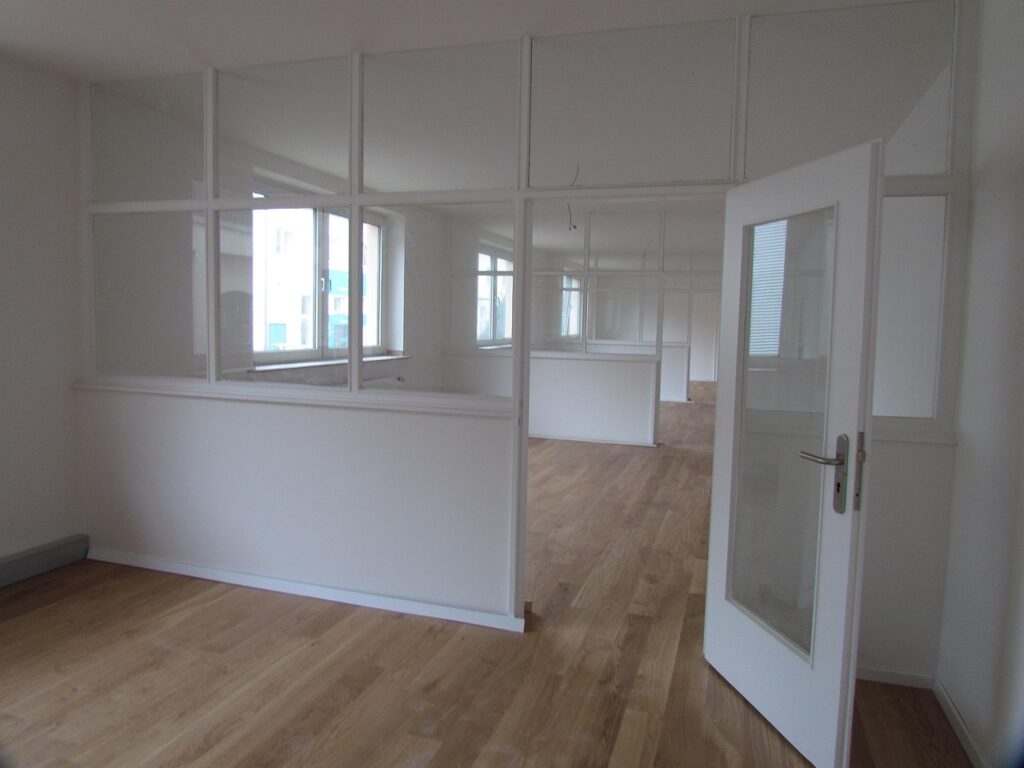
In most cases, yes. But only with the right film and the right approval process. Commercial leases usually include an “alterations” clause that requires tenants to get written permission before making changes to the space. Windows fall under that clause in most standard lease agreements.
Some landlords treat window film the same as painting, like a cosmetic change that’s acceptable with approval. Others treat it as a structural alteration requiring full restoration at move-out. The difference often depends on the film type and how it’s installed.
The safest first step is reading your lease. Look for language around “alterations,” “modifications,” “improvements,” or “restoration.” If the lease requires returning the space to its original condition, removable film is the right path.
What Landlords Usually Allow and What They Don’t
Landlord policies vary. Some property managers have clear rules about film. Others leave it to interpretation. The table below covers common patterns based on standard commercial lease terms across the US market.
Before starting, one step cuts most disputes: share the product spec sheet with your landlord or property manager before ordering anything.
| Category |
Typically allowed |
Typically restricted |
| Film type |
Removable, low-tack adhesive film |
Permanent adhesive film |
| Privacy film |
Frosted or decorative film on interior glass partitions |
Heavy tinting on exterior-facing windows without approval |
| Branded graphics |
Perforated or removable vinyl on interior glass |
Permanent graphics on exterior windows |
| Security film |
Usually allowed with written landlord approval |
May conflict with existing window warranty terms |
| Solar/heat control film |
Often allowed if the film is removable and doesn’t alter the exterior |
Dark tints that change the building’s exterior appearance |
| Removal requirement |
Film must peel off without adhesive residue |
Damage to glass or frames—tenant pays for repair |
Most disputes come from tenants who assumed approval wasn’t needed, or who chose a film type without checking the lease language first.
The Safest Window Film Options for Rental Offices
Three film categories work well in leased office spaces. All three can be removed without damage when the lease ends.
Removable film uses low-tack adhesive or static-cling technology to stay in place without permanently bonding to the glass. 3M’s window film line includes products designed for temporary commercial applications. These films peel off cleanly, even after years of use, and don’t leave adhesive behind.
This option works well for solar control, glare reduction, and light privacy. It’s common in open-plan offices with west- or south-facing windows where afternoon sun makes screen work difficult.
Frosted film gives glass a translucent appearance. It blocks direct sightlines without blocking light. Most frosted films used in commercial settings are also removable, which makes them practical for tenant spaces.
The most common applications are conference rooms, reception areas, and offices adjacent to public corridors. A frosted band at eye level creates privacy without turning the space into a closed room.
Branded film includes cut vinyl graphics, frosted logos, and decorative patterns applied to interior glass partitions or entry doors. When made from removable vinyl, this type of film peels off in one pass without heat guns or chemical solvents.
These options are designed to be removed cleanly without leaving residue or causing damage. That makes them viable for tenants who want a finished, branded look without committing to permanent changes.
What Can Get You in Trouble with Your Lease
A few mistakes come up repeatedly when tenants install window film without reviewing their lease first.
- The most common problem is using permanent adhesive film on exterior-facing glass. Permanent film bonds to the surface and often can’t be removed without scratching the glass or leaving residue behind. If the lease requires restoring the space to its original condition, that damage becomes the tenant’s liability.
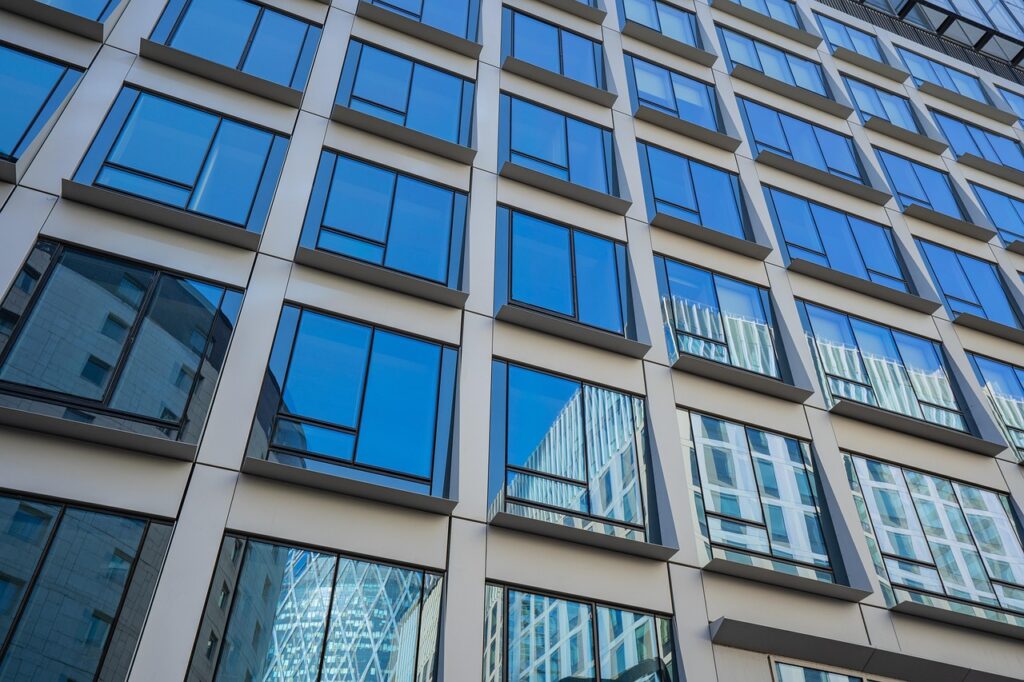
- Another issue is changing the exterior appearance of the building without approval. Many landlords have specific rules about what the building looks like from the street. A dark or reflective film on exterior windows can conflict with those rules, especially in multi-tenant buildings where the facade is managed uniformly.
- Installing film on glass covered by a manufacturer’s warranty is also a risk. Some window warranties are voided when film is applied without the glass manufacturer’s authorization. If the glass fails after the warranty is gone, the landlord may hold the tenant responsible for replacement.
Finally, skipping written approval is the single mistake that creates the most disputes. A verbal agreement from a property manager doesn’t protect you if building ownership changes or the manager moves on.
Why More Tenants Choose Window Film Instead of Renovation
Traditional office renovations in leased spaces create complications. Walls, ceilings, and flooring often require permits. Many leases prohibit structural changes entirely. Restoration costs at the end of a lease can run into thousands of dollars.
Window film addresses heat, glare, privacy, and branding without touching the structure of the space. For tenants in buildings with large glass facades, that’s a practical advantage over any renovation approach.
Cost is also a factor. According to the U.S. Department of Energy, solar control window film can reduce cooling loads in commercial buildings, which translates to lower utility bills during the lease term. That benefit comes with no permanent commitment and no permit process.
Films install in hours rather than days. With the right product, it leaves no trace at move-out. For most commercial tenants, the math is straightforward.
Work with Professionals to Stay Lease-Compliant
A professional installer does more than apply film. We help you choose the right product, confirm it’s removable, and document the installation, so you have a clear record if questions come up later.
We can also help prepare documentation for landlord approval, including product spec sheets, adhesive ratings, and removal procedures. That paperwork speeds up the approval process and reduces back-and-forth with property management.
For tenants in buildings with strict lease terms, that supports matters. Choosing the wrong film due to a miscommunication with an online retailer creates problems that are difficult and expensive to correct after installation.
We have worked in leased spaces before, so we know which films landlords typically accept and which products tend to create disputes.
Get a Lease-Friendly Window Film Solution with D&A Customs
If you’re in a leased office and want to add privacy, reduce glare, or put your brand on the glass, D&A Customs can help you do it without risking your lease.
Our team works with commercial tenants across the Seattle area and understands both installation and lease requirements. We help you choose the right film, install it properly, and avoid costly mistakes when it’s time to move out. From removable solar control film to frosted privacy panels and branded vinyl graphics, every solution is selected with lease compliance in mind.
Reach out to D&A Customs to discuss your space. If you have questions about specific lease language, bring it to the conversation—the team has enough experience with commercial leases to help you read the relevant sections.
Call 425-633-6288 or fill out the form to get a free quote.
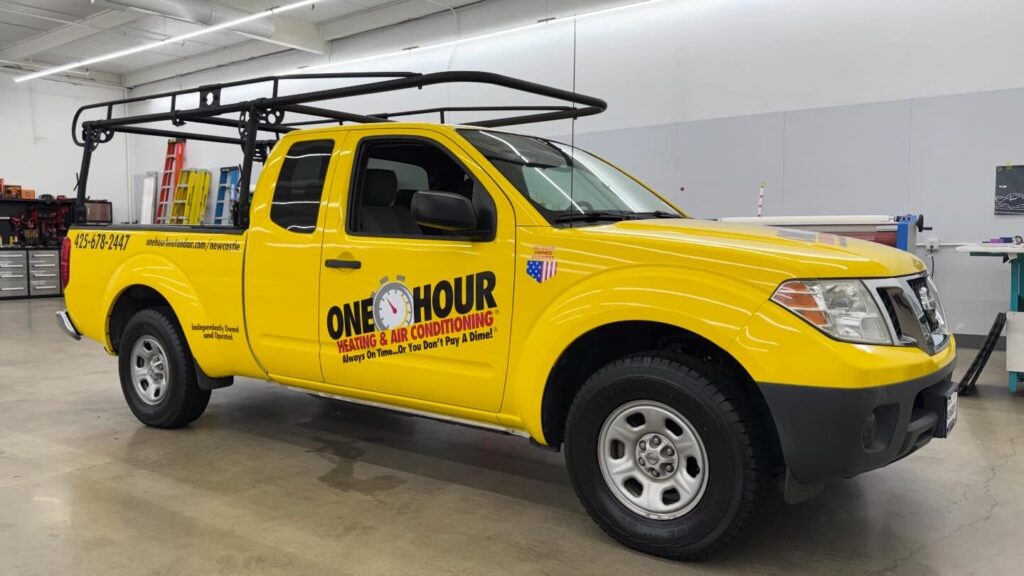
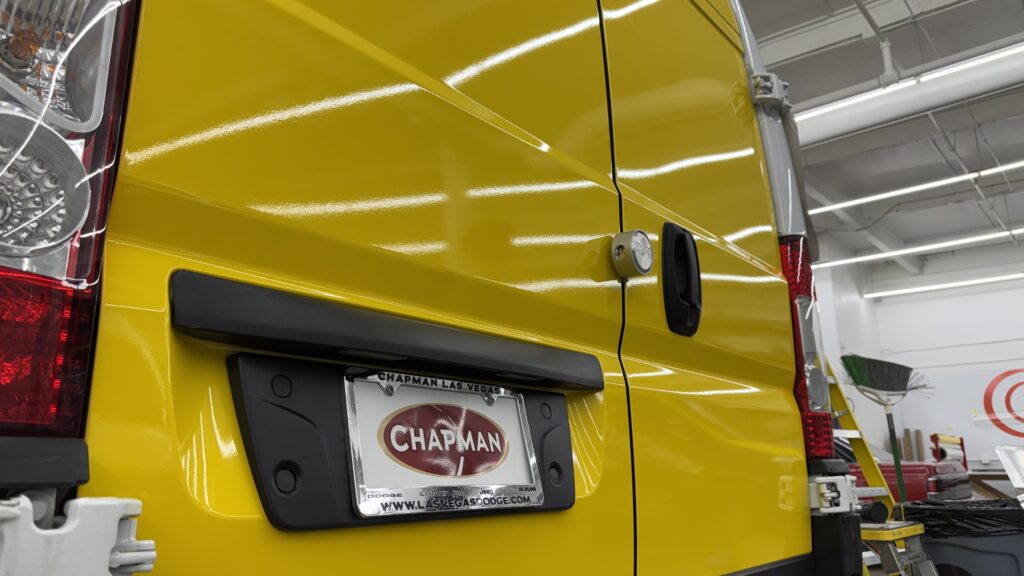
We’ve been working with One Hour Heating & Air Conditioning on a fleet wrap project across Seattle and nearby areas. They operate in multiple locations, so keeping every truck consistent and easy to recognize is a big part of how they show up in the field.
We’re wrapping several service vehicles to match their established look. The bright yellow color and bold branding make these trucks hard to miss, whether they’re on the road or parked at a job site.
Why Fleet Branding Still Works
For service companies, visibility drives trust. People tend to call the name they’ve seen before.
Fleet wraps continue to deliver strong results:
- One vehicle can generate 30,000–70,000 impressions per day in city traffic
- Around 75–90% of people remember brands they see on vehicles
- Up to 66% of consumers take action after seeing a wrapped vehicle
Every stop, every neighborhood, and every job turns into real exposure.
Built for Seattle Weather
Seattle conditions can wear down low-quality graphics fast. Rain and moisture take a toll over time. We use premium 3M wrap materials that hold up in the Pacific Northwest. Most wraps last 5–7 years with proper care, so the fleet keeps a clean and consistent look long-term.
Keeping the Fleet Consistent
When a company grows across multiple locations, brand consistency can slip. That’s where this project comes in.
Each vehicle follows the same setup:
- Same color and layout
- Clear, readable branding
- Clean installation
No guesswork. No mixed visuals. Just a strong, recognizable fleet across Seattle and the surrounding areas.
Turn Every Vehicle into a Marketing Tool
A wrapped vehicle works all day without extra ad spend. It stays visible in the exact areas you serve and keeps your brand in front of local customers. If you’re running a service business and want your fleet actually to work for you, we can help.
Let’s get your vehicles wrapped the right way—contact D&A Customs to start your fleet project.
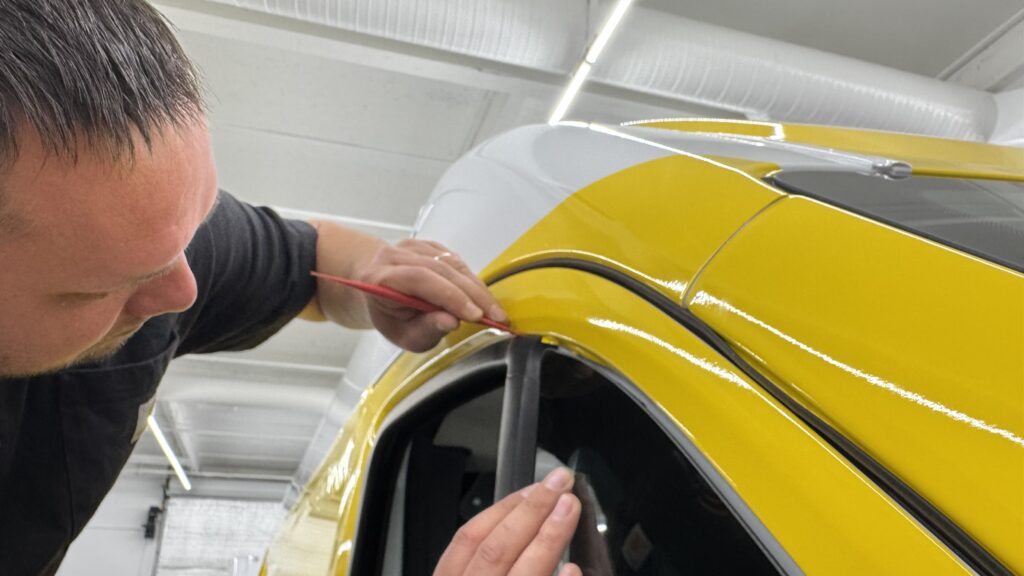
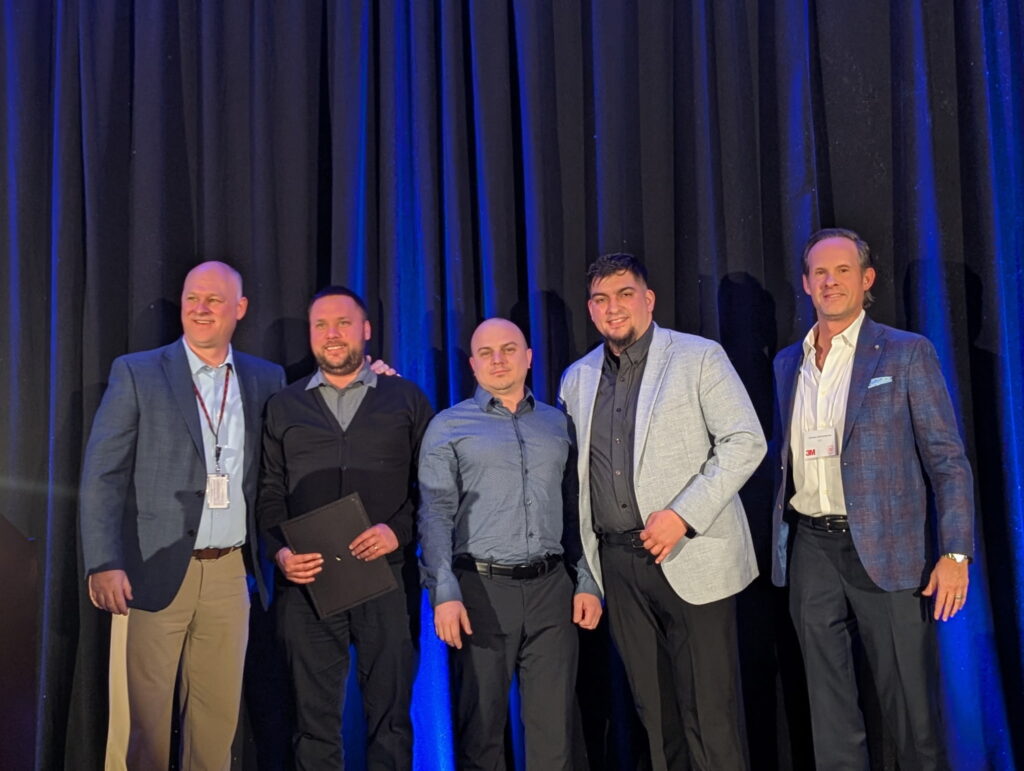
D&A Customs has received recognition from 3M as the Best New Dealer on the West Coast, which reflects the quality and consistency our team offers on every installation.
This award demonstrates a long-standing partnership between D&A Customs and 3M, one of the most respected manufacturers of window films and graphics products in the industry. From commercial window tinting and security film installations to vehicle wraps and architectural graphics, our team has focused on delivering precise work and reliable service from day one.
For our customers, this means that the materials being used to install your products are manufactured by industry-leading companies, and the final installation will be performed by professionals who consistently meet the manufacturers’ standards.
The support we have received from our clients and the 3M dealer network has enabled us to receive this kind of recognition, and it continues to motivate us to improve our craft while raising the standards of excellence for all future work we complete.
DA-Customs is proud to continue supporting the expanding Sound Transit system, with the recent addition of the new Crosslake Connection stations, which will be opening March 28. For more than six years, DA-Customs has been a provider of anti-graffiti window film services to Sound Transit, specifically within the Sound Transit rail stations.

The main focus of our work has been the application and replacement of anti-graffiti window film on the various types of glass throughout the entire station. The window film is a cost-effective solution for protecting window surfaces against tagging, surface scratches, and surface damage; it also allows for quick repair of windows when they have been vandalized, without the replacement of the glass itself. By using the anti-graffiti window film, the repair time is reduced, service disruptions are limited, and maintenance costs are reduced over the long term.
The Crosslake Connection is a major upgrade in terms of providing new access routes between the Eastside and Seattle, as well as providing new commuting options for individuals who commute daily. DA-Customs is working hard to ensure that the windows in each of the new Crosslake Connection stations will be maintained and ready for public use at all times, as the stations open.
For more information on the Crosslake Connection and opening day timeline, please visit: https://www.soundtransit.org/crosslake
The recent announcement that Alaska Airlines has made a major aircraft purchase from Boeing is quickly gaining attention across the industry. Beyond the scale of the deal itself, it highlights a broader reality: when fleets grow fast, branding becomes an operational priority, not a finishing touch.
Each new aircraft entering service must align with strict visual standards, maintain brand recognition, and stay consistent with the existing fleet. Expansion at this level requires planning that goes well beyond delivery timelines.
The same principle applies on the ground.
As fleets expand—whether in aviation, transportation, or campus operations—vehicles need to look unified from day one. That is where DA-Customs adds value. For the AAG campus shuttle fleet, DA-Customs delivered a full solution, handling design, print, and professional graphics installation to ensure consistency across multiple vehicles.
Projects like this show how fleet wraps support growth. They allow new vehicles to be deployed quickly, keep branding consistent, and make future expansion easier. As Alaska Airlines’ Boeing purchase demonstrates on a global scale, fleet growth and branding now go hand in hand—both in the air and on the road.
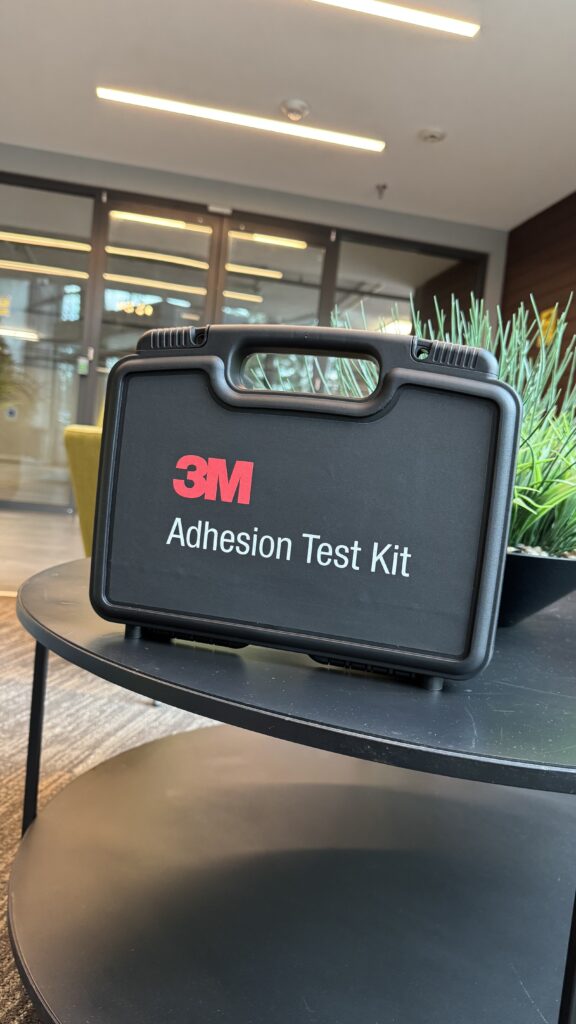
Before installing 3M DI-NOC, it is worth slowing down for a quick check that can prevent real problems later. A wall or door may look clean and solid, yet the film can still fail if the paint is too fresh, the surface is sealed, or the material has low surface energy. The 3M Adhesion Test Kit helps spot these issues before any large sheets go up. In this guide, we explain why this test matters, what it tells you about a surface, and how it helps avoid edge lift, peeling, and costly rework on DI-NOC projects.
Why You Should Adhesion-Test Before DI-NOC
A quick adhesion test can save you from the most annoying DI-NOC problems: edges that lift, corners that pull back, and panels that start to peel after the job “looks done.” 3M calls out this risk in its DI-NOC guidance and says wall paint must fully cure, plus you should run the 3M adhesion test for each product and each different wall you plan to wrap.
For the test result itself, 3M’s DI-NOC installation guide gives a clear benchmark: about 800 grams of initial adhesion (measured with a spring scale) as a recommended target to hold the film in place during installation.
What the 3M Adhesion Test Kit Is and What It Checks
The 3M adhesion test kit is a straightforward way to see how DI-NOC will behave on a real surface, not a sample board. It uses small test pieces placed right on the wall, door, or panel you plan to wrap, then checks how firmly the film holds when pulled. This matters because surfaces that look identical can act very differently. One wall may grab the film right away, while another lets it slip due to paint type, sealers, or past patchwork. The test gives a clear answer before you commit material and labor, so there are no surprises after installation.
When to Run the Adhesion Test
An adhesion test makes sense any time a surface gives you even a small reason to pause. Fresh paint is the most common case, especially low-VOC paints that feel dry to the touch but have not fully cured. 3M points out that paint cure time depends on the product and site conditions, and uncured paint can cause a weak bond or paint pull when the film is removed. 3M also recommends running adhesion tests on each surface and paint system, not just once per job. On real projects, one wall may work fine while the next fails due to a different paint batch, repair, or sealer.
How to Perform the Adhesion Test Before Installing DI-NOC
At DA-Customs, we treat the adhesion test as a standard part of every DI-NOC project, not an extra step. It helps us confirm that the surface is ready before we bring full rolls of material on-site.
- We clean the surface first. We use the same cleaning method planned for the final install, so the test reflects real conditions.
- We place small DI-NOC test strips. These go on the exact wall, door, or panel scheduled for wrapping, not on sample boards.
- We allow the proper set time. Rushing this step can give misleading results, so we follow the recommended wait time.
- We pull the strip in a controlled motion. Using the test scale, we keep a steady angle to get a clear reading.
- We review the result. A strong hold means the surface is ready. A weak hold tells us that more prep or cure time is needed.
This approach lets us make clear decisions early and helps our clients avoid edge lift, peeling, and repeat work after install.
How to Read the Test Results and Decide Next Steps
When we pull a test strip, we are looking for a clear, honest reaction from the surface. If the film stays put and takes real effort to remove, that surface is ready, and we can move forward with DI-NOC. If it lifts easily or comes off in one smooth pull, we pause the job. At DA-Customs, this often means giving fresh paint more time to cure, re-cleaning with the right method, or adjusting prep based on 3M guidance. Making that call early helps our clients avoid edge lift, peeling corners, and callbacks weeks after install.
Working with DA-Customs on DI-NOC Projects
When you choose DA-Customs for a DI-NOC install, we focus on getting it right before anything goes on the wall. Our process is built to avoid surprises and protect your space.
- Surface check on site. We review walls, doors, and panels before installation day.
- Adhesion testing where it matters. Tests are done on the actual surfaces, not sample boards.
- Clear prep plan. If a surface needs more cure time or extra prep, we explain it up front.
- Confident installation. Once the surface passes, we move forward without guesswork.
If you are planning a 3M DI-NOC project and want it done the right way from the start, contact DA-Customs to schedule a review and adhesion test before installation.