
One-way window film looks like a mirror from outside during the day. At night, once the lights go on inside, that mirror effect flips, and the glass acts like plain glass instead. This article explains why that happens, what actually controls it, and how to pick the right film for a space that needs privacy both day and night.
One-way window film does not block a view. It reflects some of the light that hits it, lets the rest pass through, and whichever side has more light looks like a mirror. During the day, sunlight outside a typical Seattle office is much brighter than the light inside. That difference is what makes the glass look like a mirror from the sidewalk and clear from the desk.
The film is a thin coated layer stuck onto a sheet of plastic. It does not “know” which way to hide a view. It just sends back a set amount of light, no matter which side that light comes from. What changes is the light levels on each side, and that comes from the sun, not the film.
This answers a question most office managers ask sooner or later: why can’t people see in during the day, while staff inside can still see out? The film is not hiding anything on purpose. It sends back light from whichever side is brighter, and during the day, that’s the outside.
3M calls this number VLT, short for visible light transmitted—the percentage of visible light that passes directly through filmed glass. The lower the VLT number, the darker the film looks, and the stronger the mirror effect during the day. This number matters more than the film’s color. Two films can look almost the same on a sample sheet and still work in different ways once installed.
A film with a VLT near 5 percent gives a strong daytime mirror and lets in very little light (illustrative example). 3M’s window films span a much wider range, from 21 to 70 percent VLT, so a lighter option can still give daytime privacy while keeping the room brighter inside. For offices around Puget Sound, where daylight is short much of the year, that choice matters day to day.
Color adds confusion here. A dark brown or gray film can look private on a sample card without having a low VLT at all. Two films with the same color can have very different VLT numbers. VLT, not color, is what actually decides whether someone outside sees a mirror or a window.
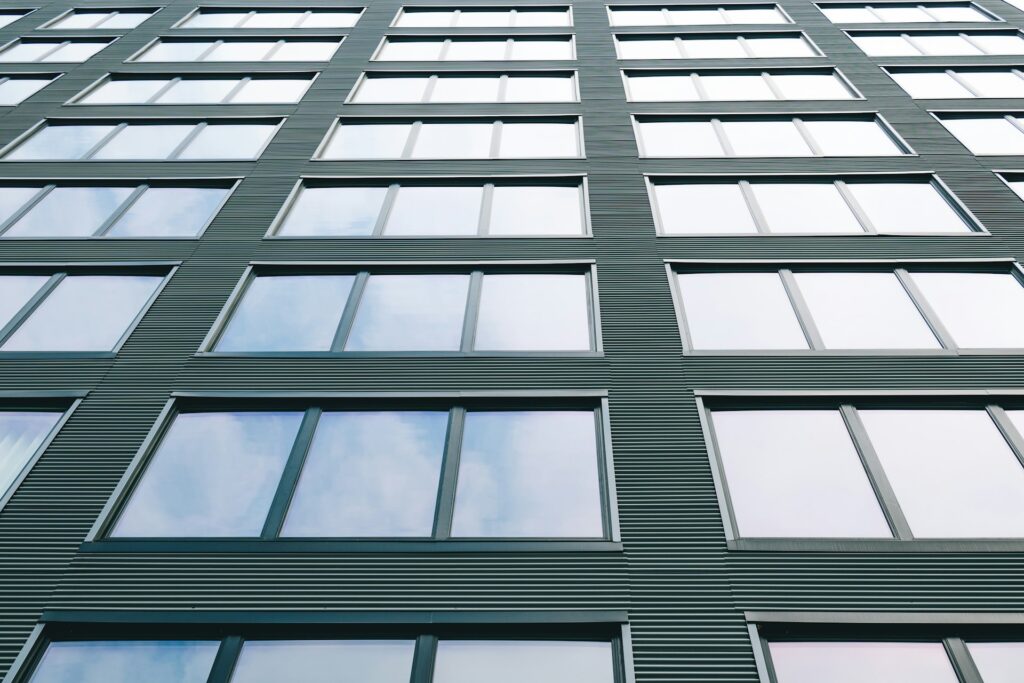
The same rule that makes daytime privacy work also turns against a building after dark. Once office lights turn on, the inside gets brighter than the outside. The mirror effect switches sides. The reflective effect is more noticeable from the brighter side has more light, and after dark, that’s inside the room.
From outside, the same window that looked like a mirror at noon acts like plain glass by 8 p.m. Anyone walking by can see straight into a lit room, desks, whiteboards, and all. This is not a flaw in the film. It’s the same rule working in reverse, and it’s why reflective film alone does not give privacy at night.
Some building managers think a pricier reflective film will fix this. It won’t. A better film blocks more heat and glare during the day. But no reflective film can change which side of the glass has more light once the sun goes down.
Reflective film and frosted film solve two different problems. Mixing them up is the top reason a privacy project falls short. Reflective film depends only on the light difference covered above, so it works best in rooms that stay dim or empty at night. Frosted film, including 3M FASARA, hides the view by scattering light instead of sending it back, so it keeps its privacy no matter which side is brighter.
Here’s how each one performs once the lights come on:
Which one you pick depends less on taste and more on how many hours the room stays lit after dark. We’ve covered how 3M FASARA decorative film works in Seattle clinics, HR offices, and conference rooms in more detail, including where it beats reflective film for evening use.
The day-to-night switch causes the biggest problem in rooms that stay lit after dark and sit in view of a public sidewalk. A few types of buildings run into this again and again:
Seattle office privacy film jobs run into this the most in ground-floor lease spaces near busy streets. Bellevue one-way window film jobs hit the same wall in buildings with evening security or cleaning shifts. The same problem shows up on Puget Sound privacy window tinting jobs for clinics and HR offices, usually after a film was picked on looks alone.
Glass inside a building runs into a smaller version of the same issue. A conference room with glass walls facing a hallway needs a different fix than outside-facing glass, since the lights inside stay on no matter the time of day. That’s a case where frosted or decorative film usually makes more sense from the start.
The right choice starts with one question: how many hours a day does this room stay lit while it’s dark outside? An office used only during work hours may not need more than standard reflective film. A conference room used for evening meetings, or a clinic that runs exams after hours, needs a film built for privacy all day and all night instead.
This is where working with a certified installer pays off. As an authorized 3M dealer, we check window direction, lighting plans, and how a room gets used before we suggest a product, not after. Matching VLT and film type to how a space is really used stops a bad surprise months later: the “privacy film” only worked until 6 p.m.
If your team is still weighing privacy film options, costs, and installation for a Seattle office or conference room, that guide is worth reading first. For frosted or decorative options, more ways to use frosted window film can help you pick a pattern or finish before a site visit.
Not sure which privacy film actually fits your space, day and night? Get a free walkthrough from our 3M-certified team. We’ll match VLT, film type, and installation to how your building really gets used after hours.